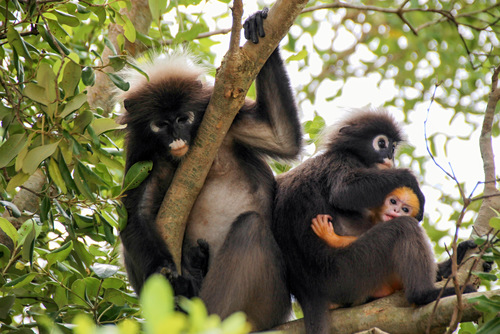
Dusky Leaf Monkey
Trachypithecus obscurus
Recognizable by their comical 'spectacles' and stunning orange infants, the Dusky Leaf Monkey is a gentle, leaf-eating gymnast of the Southeast Asian canopy.
Quick Identification
Size
Head-body length of 42–61 cm (16.5–24 in) with a tail measuring 50–85 cm (19.5–33.5 in); weight ranges from 5 to 9 kg (11–20 lbs).
Colors
Body fur is dark charcoal or brownish-grey with a lighter belly; distinctive white 'spectacle' rings around the eyes and a white patch around the mouth.
Key Features
- Large white circles around the eyes resembling glasses
- Distinctive white skin patch surrounding the mouth
- Long, slender grey tail significantly longer than the body
- Infants are born with bright orange fur
When You’ll See Them
Geographic range
Where Does the Dusky Leaf Monkey Live?
Native to the lush tropical regions of Southeast Asia, the Dusky Leaf Monkey is predominantly found throughout Peninsular Malaysia, southern Myanmar, and southwestern Thailand. Small, fragmented populations can also be found on several offshore islands and occasionally within the protected forested pockets of Singapore, where they navigate the transition between dense jungle and urban fringes.
Basemap © OpenStreetMap contributors
Behavior
Dusky Leaf Monkeys are highly social primates that typically live in groups of 5 to 20 individuals led by a dominant male. They are primarily arboreal, spent most of their time in the canopy where they move with agile leaps and cautious climbing. During the heat of the day, they are often found resting in shaded branches, becoming more active in the cooler morning and late afternoon hours as they forage for food.
Unlike some of the more aggressive macaque species found in the same regions, Dusky Leaf Monkeys are generally shy and non-confrontational. They communicate through a series of 'hoots' and 'honks' to maintain group cohesion. While they are wild animals, populations living near suburban edges or forest-bordering parks have become habituated to human presence, though they rarely approach people for food directly.
EverydayEarth exclusive
Camera Tips
To capture the Dusky Leaf Monkey, elevation is your best friend. These primates are strictly arboreal and rarely descend to the ground unless crossing a gap in the canopy. If you have a backyard bordering a forest, aim your camera at 'wildlife bridges'—overlapping branches or power lines that they use as highways. Mount your camera at least 3 to 5 meters high on a sturdy trunk to get a clear eye-level view of their movement through the middle canopy.
Because they move through dense foliage, use a camera with a fast trigger speed (0.3s or less) to avoid capturing only a disappearing tail. Video mode is highly recommended over still photos, as it captures their unique social interactions and grooming behaviors. Set your PIR sensitivity to high to account for movement through swaying leaves, and ensure your camera has a wide-angle lens to capture the full group as they follow their leader.
Baiting is generally not recommended for these monkeys as their digestive systems are specialized for leaves and human food can make them sick. Instead, position your camera near a known 'food tree' like a wild fig or a tropical almond when it is in fruit or pushing new leaf growth. They are most active in the early morning light, so ensure your camera is positioned to avoid direct lens flare from the rising sun, which can wash out the detail of their dark fur.
Similar Species
Species that look similar or are commonly confused with Dusky Leaf Monkey.
Frequently Asked Questions
Record Dusky Leaf Monkey at your habitat
Connect a camera to start building your own species record — AI identifies every visitor automatically.