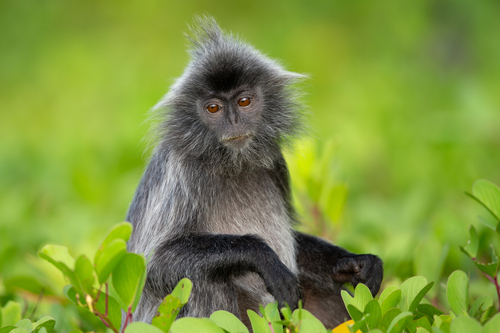
Silvered Leaf Monkey
Trachypithecus cristatus
Elegant and elusive, the Silvered Leaf Monkey is a master of the canopy with its distinctive 'frosted' fur and vibrant orange infants. Found primarily along the lush riverine and coastal forests of Southeast Asia, these gentle primates are a testament to the incredible biodiversity of the tropical wetlands.
Quick Identification
Size
Head-body length of 46–58 cm (18–23 in); Tail length of 67–75 cm (26–30 in); Weight 5–8 kg (11–18 lbs)
Colors
Dark charcoal-grey to black fur with silver-grey tips; dark skin on face, hands, and feet; infants are bright orange.
Key Features
- Prominent crest of hair on top of the head
- Silver-tipped dark fur creating a 'frosted' look
- Long, slender tail significantly longer than the body
- Whiskered face with no hair on the dark skin
- Infants are born with striking orange fur and white skin
When You’ll See Them
Geographic range
Where Does the Silvered Leaf Monkey Live?
The Silvered Leaf Monkey is a specialist of the tropical coastal regions of Southeast Asia. Its native range is anchored in the Malay Peninsula and extends across the Great Sunda Islands, including Sumatra, Borneo, and Java. These primates are particularly abundant in the mangrove-rich shorelines and riverine corridors of Indonesia, Malaysia, and Brunei, and can also be found on several smaller archipelagos like the Natuna Islands.
Basemap © OpenStreetMap contributors
Behavior
Silvered Leaf Monkeys are highly social, arboreal primates that live in groups typically led by a single dominant male and several adult females with their offspring. Unlike the more boisterous macaques often found in the same regions, these monkeys are generally quieter and more cautious. They spend the vast majority of their lives in the canopy, moving with impressive agility through the branches using all four limbs, though they are capable of spectacular leaps when crossing gaps in the forest.
One of their most fascinating social behaviors is 'allomothering,' where females other than the mother help care for the infants. This is particularly visible because the infants are born a bright, vivid orange—a stark contrast to the adults' silver-black coats. This color difference is thought to trigger protective instincts in the group. While they are wary of humans in deep forest settings, populations living near coastal resorts or forest edges have become habituated and can be observed at closer range, though they rarely approach people for food like some other monkey species.
EverydayEarth exclusive
Camera Tips
Capturing the Silvered Leaf Monkey on camera requires an 'upward' perspective. Since they are strictly arboreal and rarely descend to the ground, trail cameras should be mounted at height, ideally 10 to 15 feet up a tree trunk. Focus your efforts on 'arboreal highways'—sturdy, horizontal branches that connect the canopies of different trees, as these are the primary transit routes for the troop.
Because they are most active during the cooler parts of the morning and late afternoon, ensure your camera's trigger speed is set to its fastest setting. These monkeys are fast movers; a slow trigger will often result in a 'ghost' or a trailing tail. High-resolution video is often better than stills for this species, as it captures the fluid motion of their leaps and the complex social grooming sessions that occur during their midday rest periods.
If you are setting up in a backyard or garden near a forest edge, do not bother with traditional ground baits like corn or seeds. Instead, position cameras near fruiting trees (like wild figs) or trees with fresh, young leaf growth. In coastal areas, focusing on the edge where mangroves meet the land provides the best lighting. Be mindful of the high humidity in their tropical habitat; use desiccant packets inside your camera housing to prevent lens fogging during the early morning hours.
Similar Species
Species that look similar or are commonly confused with Silvered Leaf Monkey.
Dusky Leaf Monkey
Look for prominent white 'spectacle' rings around the eyes and a white patch around the mouth, which the Silvered Leaf Monkey lacks.
Long-tailed Macaque
Macaques have brown/tan fur, no silver tipping, and a more protruding muzzle compared to the flatter face of the leaf monkey.
Javan Lutung
Closely related but found primarily in Java; some individuals remain orange throughout their lives, unlike the Silvered Leaf Monkey which turns grey.
Frequently Asked Questions
Record Silvered Leaf Monkey at your habitat
Connect a camera to start building your own species record — AI identifies every visitor automatically.