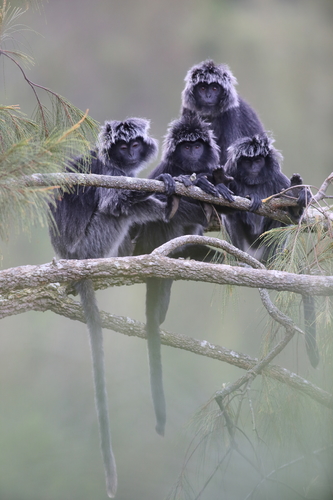
Javan Lutung
Trachypithecus auratus
Meet the glossy acrobat of the Indonesian archipelago. Whether in their signature ebony coat or the rare golden morph, the Javan Lutung is a master of the canopy and a symbol of Java's vibrant biodiversity.
Quick Identification
Size
Body length 44–65 cm (17–26 in); Tail length 61–87 cm (24–34 in); Weight around 7 kg (15.4 lbs)
Colors
Typically glossy jet-black with brownish-red tinges on the limbs; a rarer 'golden' morph exists which is a vibrant orange-red color.
Key Features
- Extraordinarily long, non-prehensile tail used for balance
- Puffy, distinct sideburns and facial hair tufts
- Slender, athletic build optimized for leaping
- Infants are born bright orange regardless of adult color morph
When You’ll See Them
Geographic range
Where Does the Javan Lutung Live?
Native to the tropical islands of the Indonesian archipelago, the Javan Lutung is found across the island of Java. Its presence also extends to the neighboring islands of Bali and Lombok. They are most concentrated in protected national parks and remote forested regions, though they are increasingly seen on the fringes of agricultural land as their natural habitats become fragmented.
Basemap © OpenStreetMap contributors
Behavior
The Javan Lutung is a highly social primate, typically living in groups of 5 to 20 individuals. These groups are usually led by a single dominant male and include several females and their offspring. Within the troop, social bonding is reinforced through grooming and vocalizations, though the males are known to be fiercely territorial when encountering rival groups.
As diurnal creatures, they are most active during daylight hours, spending nearly their entire lives in the upper canopy of the forest. They are exceptional acrobats, capable of making massive leaps between branches using their long tails for stabilization. While they are generally shy around humans, they have become habituated to observers in specific protected parks and forest edges.
EverydayEarth exclusive
Camera Tips
To capture high-quality footage of the Javan Lutung, you must look up. These monkeys are arboreal specialists and rarely descend to the ground unless absolutely necessary. Mounting your camera 3 to 5 meters high on a sturdy trunk facing a known 'canopy bridge'—a place where branches from two trees meet—is your best strategy for seeing them in motion.
Look for signs of feeding, such as freshly dropped half-eaten fruit or stripped leaves, and place your camera nearby. Fruiting Ficus trees are a magnet for these primates. Because they move with incredible speed when jumping, set your camera to a fast trigger speed (0.2 seconds or less) and use the 'Burst' mode to ensure you don't just catch a departing tail.
In tropical environments, lens fogging is a major issue. Use anti-fog desiccant packets inside your camera housing and try to position the lens so it isn't facing the direct morning sun, which can cause 'white-out' and trigger the PIR sensor prematurely. If you are on the edge of a backyard or plantation, aim the camera at the highest visible branches where the forest canopy begins.
Similar Species
Species that look similar or are commonly confused with Javan Lutung.
Frequently Asked Questions
Record Javan Lutung at your habitat
Connect a camera to start building your own species record — AI identifies every visitor automatically.