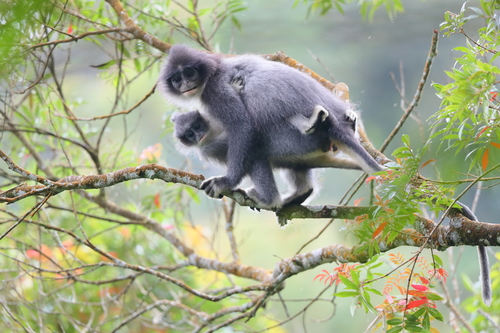
Javan Surili
Presbytis comata
A silver-grey ghost of the Indonesian canopy, the Javan Surili is one of Java's most iconic yet elusive primates. With its distinctive punk-rock crest and acrobatic leaps, this endemic monkey is a treasure of the western rainforests.
Quick Identification
Size
Head-body length of 43–60 cm (17–24 in) with a tail reaching 56–72 cm (22–28 in); weighs 6–7 kg (13–15 lbs).
Colors
Grizzled grey or silver-grey upperparts with a contrasting white underbelly and inner limbs; blackish crest on the head.
Key Features
- Distinctive pointed black crest on the crown
- Grizzled grey-to-black fur with bright white underside
- Extremely long tail significantly longer than the body
- Dark face often framed by lighter fur around the cheeks.
When You’ll See Them
Geographic range
Where Does the Javan Surili Live?
Native exclusively to the island of Java in Indonesia, the Javan Surili is a true island endemic. Its core range is restricted to the western half of the island, where it inhabits the remaining patches of primary and secondary rainforest. Unlike some other primates, it has no introduced populations elsewhere, making its survival entirely dependent on the preservation of West Java's high-altitude and lowland forest fragments.
Basemap © OpenStreetMap contributors
Behavior
The Javan Surili is a highly social primate that lives in small, cohesive groups, usually consisting of a single dominant adult male and several females with their offspring. They are primarily arboreal, meaning they spend the vast majority of their lives in the canopy, where they move with incredible agility. They are famous for their "leaping" locomotion, often jumping several meters between branches to navigate the dense Javanese forests.
These monkeys are diurnal, starting their day early to forage for fresh leaves. While they are generally shy and avoid human contact, they can sometimes be seen near forest edges or in shaded plantations if there is enough tree cover. They communicate through a variety of vocalizations, including loud, rattling alarm calls used to warn the troop of predators like eagles or the Javan leopard.
EverydayEarth exclusive
Camera Tips
Capturing the Javan Surili on camera requires thinking vertically. Since these monkeys are almost exclusively arboreal, a ground-level camera will likely only catch a glimpse of them if they descend for water or travel across a gap. For the best results, secure your camera to a sturdy branch 5 to 10 meters up in the canopy, focusing on "arboreal highways"—horizontal branches that connect large fruit trees or provide clear paths through the forest mid-story.
Because they are wary of humans and have excellent eyesight, use a camera with a "no-glow" or black LED infrared flash to avoid spooking the troop during low-light hours. Ensure the trigger speed is set as fast as possible (0.2 seconds or less), as these monkeys are remarkably quick leapers. Setting your camera to burst mode or a short video clip (10-20 seconds) is highly recommended to capture their fluid movement and social interactions.
While traditional "backyard" baiting isn't effective for this specialist leaf-eater, positioning your camera near a known feeding tree—specifically those with young, tender shoots or seasonal wild fruits—is the best way to ensure they linger in the frame. If you are in a location where the forest meets a garden or plantation, look for corridors of tall trees they use to travel. Early morning light provides the best clarity for their grizzled fur, so aim your camera south or north to avoid direct lens flare during their peak activity hours.
Similar Species
Species that look similar or are commonly confused with Javan Surili.
Frequently Asked Questions
Record Javan Surili at your habitat
Connect a camera to start building your own species record — AI identifies every visitor automatically.