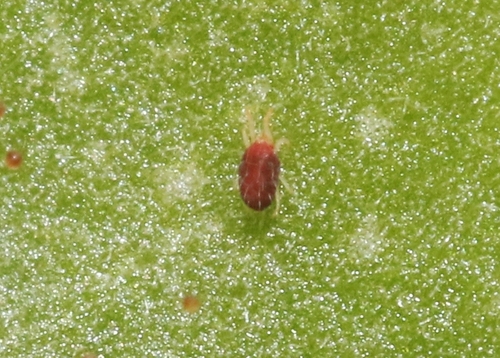
Carmine Spider Mite
Tetranychus cinnabarinus
The Carmine Spider Mite is a tiny but vibrant architect of the undergrowth, famous for its brilliant red hue and the intricate silk cities it weaves beneath leaves. Though microscopic, its impact on the garden landscape is immense.
Quick Identification
Size
Extremely minute, ranging from 0.4 to 0.5 mm (0.016 to 0.02 inches) in length.
Colors
Adult females are a distinctive carmine red or deep reddish-orange; males are smaller, paler, and more yellowish-green or light orange.
Key Features
- Vibrant carmine red body color in adult females
- Produces fine, silvery silk webbing on leaf undersides
- Oval-shaped body with eight legs (six in the larval stage)
When You’ll See Them
Geographic range
Where Does the Carmine Spider Mite Live?
The Carmine Spider Mite is a truly cosmopolitan species, thriving on nearly every continent where host plants are available. Originally thought to be native to tropical and subtropical regions of Asia and Africa, it has since spread throughout the Mediterranean, the Americas, and Oceania. In cooler temperate regions like Northern Europe and Canada, it is a persistent resident of greenhouses and indoor botanical collections, though it can flourish outdoors during the height of summer.
Basemap © OpenStreetMap contributors
Behavior
The Carmine Spider Mite is a highly social but microscopic arachnid that lives in dense colonies, primarily on the undersides of leaves. They are master weavers, producing fine silk webbing that protects the colony from predators and creates a controlled microclimate. These mites are most active during hot, dry weather, which accelerates their life cycle from egg to adult in as little as a week.
Their interaction with the environment is primarily defined by their feeding mechanism. They use needle-like mouthparts to pierce individual plant cells and suck out the chlorophyll. This leads to a characteristic 'stippling' effect—tiny white or yellow dots on the surface of leaves. While they are considered pests in agricultural and garden settings, they are a vital food source for predatory mites and ladybugs.
EverydayEarth exclusive
Camera Tips
Capturing the Carmine Spider Mite on a backyard camera requires specialized equipment, as these creatures are smaller than a grain of salt. To see them clearly, you must use a dedicated macro lens or an AI-powered camera with a high-magnification 'micro' mode. Focus your lens on the undersides of leaves that show signs of 'stippling'—light-colored speckling on the top surface. The mites will likely be clustered near the leaf veins or under the protection of their silk webs.
Lighting is the most critical factor for a clear shot. Because they are so small, standard camera sensors struggle with depth of field. Use a bright, external light source or a ring light to illuminate the leaf from the side; this 'cross-lighting' will highlight the texture of their red bodies and make the delicate silk webbing shimmer against the green background. If your camera allows for it, use a high shutter speed to freeze the movement of the mites, as they move surprisingly fast for their size.
Set your camera on a stable tripod or a flexible arm attached directly to the plant stem. Even the slightest breeze can move the leaf out of focus, so indoor observations or using a windbreak outdoors is recommended. Look for them during the hottest part of the day when they are most active. For the best 'action' shots, try to find a leaf where a predatory mite (like Phytoseiulus persimilis) is present, as you may capture rare footage of the Carmine Spider Mite's defensive behaviors within its web.
Similar Species
Species that look similar or are commonly confused with Carmine Spider Mite.
Frequently Asked Questions
Record Carmine Spider Mite at your habitat
Connect a camera to start building your own species record — AI identifies every visitor automatically.