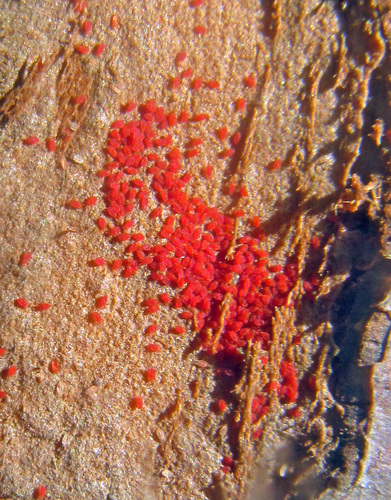
European Red Mite
Panonychus ulmi
Though tiny enough to fit on a pinhead, the European Red Mite is a vibrant, crimson powerhouse of the backyard ecosystem. These fast-moving arachnids are a masterclass in adaptation, thriving in orchards and gardens across the globe.
Quick Identification
Size
Adults measure approximately 0.3 to 0.4 mm (0.012 to 0.016 inches) in length; eggs are even smaller at 0.1 mm.
Colors
Brick red to dark reddish-brown body with prominent white spots (tubercles) at the base of dorsal hairs
Key Features
- Tiny, oval-shaped brick-red body
- Long, curved white bristles (setae) protruding from white spots on the back
- Eight legs in adults (six in larvae)
- Found primarily on the undersides of leaves
When You’ll See Them
Geographic range
Where Does the European Red Mite Live?
Originally native to Europe, the European Red Mite has achieved a truly cosmopolitan distribution by following the global trade of fruit trees. It is now widely established across the temperate regions of North America, South America, Asia, and Australasia. In the United States and Canada, it is a ubiquitous presence in almost every commercial apple-growing region and is frequently found in suburban backyards wherever Rosaceae family trees are planted.
Basemap © OpenStreetMap contributors
Behavior
The European Red Mite is a highly active arachnid known for its rapid reproductive cycle, often producing five to ten generations in a single growing season. These mites spend their entire lives on the host plant, moving from the bark where they overwinter as eggs to the lush green leaves during the spring and summer. They are solitary feeders but can congregate in massive numbers when conditions are hot and dry, which accelerates their development.
While they do not interact with humans directly, their presence is felt through the "bronzing" effect they have on foliage. When populations explode, their feeding can cause leaves to turn a dull brown or leaden color, which can weaken the tree and reduce fruit yield. Interestingly, they are quite mobile for their size and can be dispersed across orchards by the wind, a process sometimes called 'ballooning' or passive aerial dispersal.
EverydayEarth exclusive
Camera Tips
Capturing the European Red Mite requires a specialized approach because of its microscopic size. A standard trail camera will not suffice; instead, use an AI-powered camera equipped with a high-quality macro lens or a digital microscope attachment. Focus your lens on the underside of leaves from known host plants like apple, cherry, or plum trees. Because these mites are so small, keeping the camera perfectly still with a tripod or fixed mount is essential to prevent motion blur.
Lighting is the most critical factor for visibility. Use side-lighting or back-lighting to make the mite's translucent bristles and brick-red body pop against the green background of the leaf. If your camera has a manual focus or "macro lock" feature, use it to hone in on the midrib of the leaf where mites often congregate to feed. Early afternoon is the best time for photography, as the higher temperatures make the mites more active and likely to move across the leaf surface.
For the best results, look for trees showing signs of 'bronzing' or yellow stippling on the leaves, as this indicates a high-density population. You don't need bait for these creatures; the host plant itself is the lure. Try to position your camera in a sheltered area, as even a light breeze can move the leaf out of the narrow focal plane of a macro lens. If your AI camera supports high-frame-rate video, use it to capture their scurrying movements, which can help the AI distinguish them from specks of dust or pollen.
Similar Species
Species that look similar or are commonly confused with European Red Mite.
Frequently Asked Questions
Record European Red Mite at your habitat
Connect a camera to start building your own species record — AI identifies every visitor automatically.