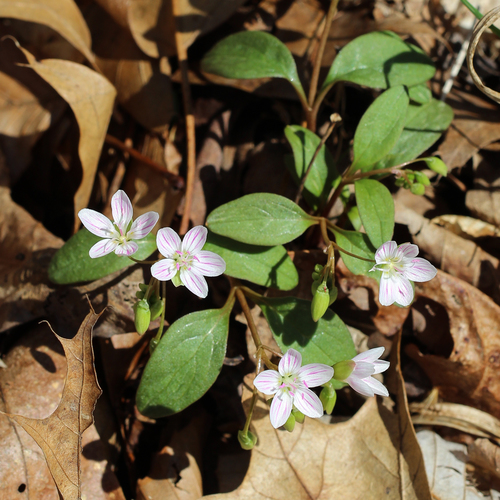
Carolina Springbeauty
Claytonia caroliniana
A delicate herald of the changing seasons, the Carolina Springbeauty carpets the forest floor in a soft pink hue long before the trees have leaves. This hardy perennial is a favorite for early pollinators and a cherished sight for spring hikers.
Quick Identification
Size
5–20 cm (2–8 inches) in height with flowers approximately 1–2 cm (0.4–0.8 inches) wide
Colors
White to pale pink petals with distinct dark pink veins; bright green foliage
Key Features
- Broad, oval-to-lanceolate leaves on distinct short stalks
- Five-petaled flowers with prominent pink 'nectar guide' veins
- Pair of small green sepals at the base of each flower
- Underground tuberous roots (corms) that resemble small potatoes
When You’ll See Them
Geographic range
Where Does the Carolina Springbeauty Live?
The Carolina Springbeauty is a native gem of North America, found primarily across the eastern and central regions of the continent. Its heartland lies within the Appalachian Mountains and the northeastern United States, but its reach extends as far north as the Cape Anguille Mountains of Newfoundland and west into Ontario. Heading south, it populates the rich, deciduous woodlands through the Piedmont into Alabama, thriving in the cool, moist soils of temperate broadleaf forests.
Basemap © OpenStreetMap contributors
Behavior
The Carolina Springbeauty is a quintessential 'spring ephemeral,' a group of plants that completes its entire reproductive cycle in the short window between the ground thawing and the forest canopy leafing out. This plant is highly sensitive to light and temperature; its flowers exhibit 'nyctinasty,' meaning they close tightly at night and during overcast days to protect their pollen from moisture and cold. During sunny intervals, they track the sun across the sky to maintain optimal temperatures for nectar production.
Because they bloom when few other sources of food are available, they play a vital role in the ecosystem by supporting early-emerging pollinators. They often grow in dense colonies, creating a lush, carpeted effect on the forest floor. Once the trees overhead produce a full canopy of leaves, the above-ground portions of the Carolina Springbeauty quickly wither and disappear, with the plant surviving the rest of the year as a dormant underground corm.
EverydayEarth exclusive
Camera Tips
Capturing the Carolina Springbeauty requires a specialized approach because of its small stature. Mount your AI camera at ground level, ideally using a spike mount or a low-profile tripod. To get the most aesthetic shot, position the lens slightly below the flower head and tilt it upward; this creates a 'worm’s-eye view' that makes these 6-inch plants look majestic and highlights the delicate pink veining on the petals against the sky or forest canopy.
Since these plants don't move (other than swaying in the breeze), traditional motion triggers are less effective. Instead, utilize the 'Time Lapse' or 'Field Scan' mode on your camera. Setting the camera to take a photo every 5 to 10 minutes from sunrise to sunset will allow you to capture the spectacular sight of the flowers opening and closing in response to the light. This is the best way to document the plant's unique behavior and ensure you get a shot when the blossoms are at their fullest.
Pay close attention to lighting. These flowers look best in dappled sunlight, which emphasizes their translucent petals. However, if your camera has a flash, be wary of using it at close range as it can wash out the subtle pink 'nectar guides.' If you are using an AI-powered camera to identify visiting insects, ensure you have a high shutter speed enabled, as the primary pollinators—like the Spring Beauty Mining Bee—are fast-moving and only visit when the sun is brightest.
Similar Species
Species that look similar or are commonly confused with Carolina Springbeauty.
Frequently Asked Questions
Record Carolina Springbeauty at your habitat
Connect a camera to start building your own species record — AI identifies every visitor automatically.