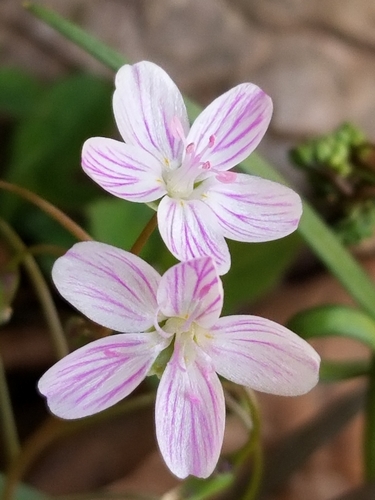
Virginia Springbeauty
Claytonia virginica
A delicate herald of the changing seasons, the Virginia Springbeauty transforms the forest floor into a sea of candy-striped blossoms. These resilient 'fairy spuds' are a vital early-season lifeline for native pollinators and a favorite find for backyard naturalists.
Quick Identification
Size
Height of 8-40 cm (3-16 inches); leaves are 5-20 cm (2-8 inches) long
Colors
White to pale pink petals with distinctive dark pink or rose-colored veins; bright pink anthers; deep green foliage
Key Features
- Narrow, grass-like leaves occurring in pairs
- Five petals with pink stripes/veining
- Pink-tipped stamens (anthers)
- Clump-forming growth habit, often creating a carpet effect
When You’ll See Them
Behavior
The Virginia Springbeauty is a quintessential "spring ephemeral," a plant that completes its above-ground life cycle rapidly in the early spring before the forest canopy fills in and blocks the sunlight. These hardy perennials emerge from small, underground tubers that resemble tiny potatoes, earning them the whimsical nickname "fairy spuds." They are highly sensitive to light and temperature; the flowers remain tightly closed on cloudy days and at night to protect their pollen, a movement known as nyctinasty.
Interaction with wildlife is central to this species' survival. They provide one of the first nectar and pollen sources for native bees, particularly the specialist mining bee (Andrena erigeniae), which relies almost exclusively on this plant to feed its young. In the home garden or suburban woodland, they are docile and non-aggressive, often colonizing lawns where they create a beautiful, temporary meadow if the first mowing of the year is delayed.
EverydayEarth exclusive
Camera Tips
To capture the Virginia Springbeauty effectively, you need to think like a ground-dweller. Since these plants rarely exceed 6 inches in height, your camera should be mounted on a low-profile stake or even placed directly on a weather-proof brick at ground level. Angle the lens slightly upward (about 15-20 degrees) to capture the delicate pink veins inside the flower bells. If your AI camera has a macro mode or adjustable focus, set it to a close-range focal point of about 12-18 inches to distinguish the pink anthers from the white petals.
Timing is everything for this species. Because the flowers close up tight in the evening, the best "action" occurs during the late morning. Use the time-lapse feature on your trail camera to capture the dramatic "waking up" process as the sun hits the patch. Set an interval of one photo every 5-10 minutes from 8:00 AM to 11:00 AM. This will reveal the flower heads tracking the sun and slowly unfurling their petals in response to the warmth.
If you are using an AI-powered camera to detect wildlife, place it near a dense cluster of Springbeauties on a warm, calm day. This plant is a magnet for the Spring Beauty Mining Bee and various hoverflies. By setting your camera to its highest sensitivity and using a fast shutter speed, you can trigger captures of these specialized pollinators in mid-flight. Avoid using heavy baits or lures near the flowers as they may attract larger mammals like deer or rabbits that might trample or eat the delicate blossoms before you get the shot.
Lighting is your biggest challenge and greatest asset. The bright white petals can easily "blow out" or overexpose in direct, harsh midday sun. If possible, position your camera so the flowers are backlit by the morning sun; this will make the pink veins glow and highlight the fine hairs on the stems. In shaded woodland settings, ensure your camera’s white balance is set to 'Cloudy' to prevent the white flowers from looking too blue or cold in the final images.
Similar Species
Species that look similar or are commonly confused with Virginia Springbeauty.
Frequently Asked Questions
Record Virginia Springbeauty at your habitat
Connect a camera to start building your own species record — AI identifies every visitor automatically.