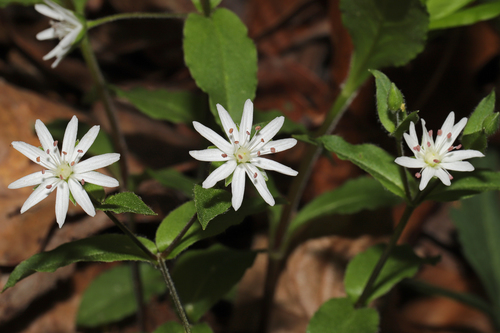
star chickweed
Stellaria pubera
A woodland gem that mimics the night sky, Star Chickweed is one of the brightest heralds of the eastern spring. Its deeply notched white petals create a perfect celestial geometry on the forest floor.
Quick Identification
Size
Height of 6-12 inches (15-30 cm); flower diameter of 0.5-1 inch (1.3-2.5 cm)
Colors
Brilliant white petals with contrasting dark purple or reddish-brown anthers at the center; light green stems and foliage
Key Features
- Five deeply cleft petals that appear to be ten distinct petals
- Two distinct lines of fine hairs running longitudinally down the stem
- Opposite, stalkless (sessile) leaves that are oval or lance-shaped
- Star-like symmetrical bloom with 10 prominent stamens
When You’ll See Them
Behavior
Star chickweed is a hardy spring ephemeral that brings a burst of white to the forest floor long before many other wildflowers have woken up. Unlike its more invasive relatives, this native perennial grows in polite, mounded clumps. It is highly sensitive to environmental conditions; the flowers typically open wide during bright, sunny mornings to attract early-season pollinators but will remain partially closed on heavily overcast or rainy days to protect their pollen.
As a key component of the early spring ecosystem, star chickweed serves as a vital nectar source for native bees, syrphid flies, and giant bee flies. While it doesn't move in the traditional sense, the plant exhibits a fascinating growth spurt in early April, quickly expanding its foliage to capture sunlight before the forest canopy fully closes and shades the ground. By mid-summer, the plant often goes dormant or becomes less conspicuous as larger summer vegetation takes over.
EverydayEarth exclusive
Camera Tips
To capture the delicate beauty of star chickweed, you need to get low. For standard trail cameras, place the device on a specialized ground stake or mount it to a low-lying rock no more than 6 to 10 inches off the ground. Because the flowers are relatively small, check if your camera has a macro focal setting; otherwise, ensure the lens is at least 2 feet away to maintain focus. If you are using an AI-powered camera with a high frame rate, angle it slightly downward to capture the 'star' shape of the petals from above.
Time-lapse mode is the secret weapon for this species. Set your camera to take a photo every 15 to 30 minutes during the daylight hours of late March and April. When stitched together, this footage will reveal the plant's 'sleep movements,' showing the flowers opening in the morning sun and bowing their heads as evening approaches. This is a fantastic way to document the transition from bud to full bloom over several days.
Don't just focus on the plant itself—use the star chickweed as a 'pollinator stage.' Because these flowers are high-traffic areas for early spring insects, setting your camera to its most sensitive motion trigger can help you capture rare footage of native solitary bees and hoverflies. Position the camera so the sun is behind it (facing north or east in the morning) to prevent the white petals from 'blowing out' or overexposing in the bright spring light.
Finally, consider the background. Since star chickweed often grows near leaf litter or dark soil, the contrast can be quite sharp. Placing your camera during a slightly overcast day will provide softer, more even lighting that highlights the subtle textures of the hairy stems and the dark purple anthers. If you are monitoring a specific clump, clear away any tall dead grass or distracting twigs that might blow in the wind and cause false motion triggers.
Similar Species
Species that look similar or are commonly confused with star chickweed.
Frequently Asked Questions
Record star chickweed at your habitat
Connect a camera to start building your own species record — AI identifies every visitor automatically.