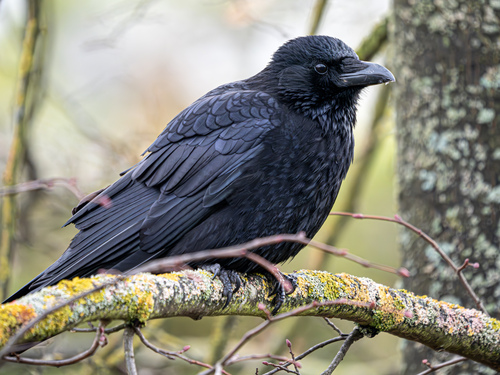
Carrion Crow
Corvus corone
The Carrion Crow is the brilliant, black-clad intellectual of the backyard. Renowned for their problem-solving and social complexity, these birds turn every garden visit into a display of high-level avian intelligence.
Quick Identification
Size
Length: 45–52 cm (18–20 in); Wingspan: 93–104 cm (37–41 in); Weight: 370–650 g (13–23 oz)
Colors
Uniformly glossy black plumage with a subtle green or purple iridescence; bill, legs, and feet are also black.
Key Features
- Entirely black plumage with a metallic sheen
- Heavier, more curved bill than a Rook or American Crow
- Square-ended tail visible during flight
- Stocky, powerful build
When You’ll See Them
Geographic range
Where Does the Carrion Crow Live?
Native to the Western Palearctic and parts of East Asia, the Carrion Crow is a common sight across much of Western Europe. Its core range extends from the British Isles and France through Germany to Switzerland and Italy, where it eventually meets the range of its close relative, the Hooded Crow. A separate but significant population thrives in the Eastern Palearctic, covering vast areas of Siberia, Japan, and parts of China. While they are predominantly resident birds that stay in their territory year-round, those in the coldest northern reaches may move slightly south during harsh winters.
Basemap © OpenStreetMap contributors
Behavior
These birds are famous for their 'caching' behavior, where they hide surplus food in the ground or under leaf litter to retrieve later. Their social lives are complex; they are known to defend territories fiercely but will also engage in 'social play' and vocal mimicry. In urban settings, they have even been observed using traffic to crack open hard-shelled nuts, waiting for the lights to change before retrieving their prize.
EverydayEarth exclusive
Camera Tips
To capture the best footage of a Carrion Crow, you must outsmart one of the world's most observant birds. Crows are naturally 'neophobic'—they are suspicious of new objects. When you first place your camera, don't be surprised if they avoid it for a few days. Masking the camera with some local foliage or placing it near a familiar bird feeder can help them accept it as part of the landscape.
Placement is key for these ground-foragers. Set your camera low to the ground, roughly 12 to 24 inches high, aimed at a flat, open area of your lawn or a specific 'feeding station' like a flat stump. Because their plumage is so dark, avoid pointing the camera directly into the sun, which can cause them to look like a featureless silhouette. Instead, aim for a spot with bright, indirect light to capture the beautiful purple and green sheen of their feathers.
High-value baits like unsalted peanuts (in the shell), suet, or even small pieces of leftover meat will quickly draw their attention. Once one crow finds the food, its 'caw' will likely alert others. If you want to see their intelligence in action, try placing the food inside a simple container that requires them to lift a lid or pull a string—these 'puzzle' moments make for incredible, viral-worthy trail cam footage.
Similar Species
Species that look similar or are commonly confused with Carrion Crow.
Rook
Rooks have a distinct patch of bare, grey-white skin at the base of the bill, whereas the Carrion Crow's bill is fully feathered at the base.
Common Raven
Ravens are much larger with a shaggy 'throat beard' and a wedge-shaped tail, compared to the crow's square tail.
Hooded Crow
Identical in shape and size, but the Hooded Crow has a distinctive ash-grey body with a black head, wings, and tail.
Frequently Asked Questions
Record Carrion Crow at your habitat
Connect a camera to start building your own species record — AI identifies every visitor automatically.