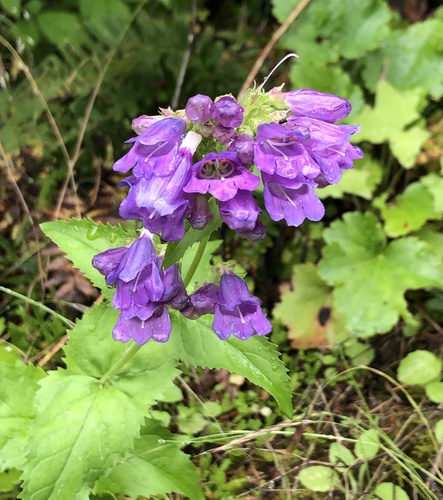
Cascade Beardtongue
Penstemon serrulatus
A vibrant purple beacon for hummingbirds, the Cascade Beardtongue thrives where the mountains meet the mist. Its saw-toothed leaves and tubular blooms make it a stunning centerpiece for any Pacific Northwest backyard.
Quick Identification
Size
20 to 70 cm (8 to 28 inches) in height
Colors
Deep blue to vibrant purple or pinkish-purple flowers; dark green foliage with reddish stems
Key Features
- Tubular flowers in dense clusters or whorls
- Sharply serrated (saw-toothed) lance-shaped leaves
- Opposite leaf arrangement along the stem
- A 'bearded' sterile stamen (staminode) covered in fine yellow hairs
When You’ll See Them
Geographic range
Where Does the Cascade Beardtongue Live?
The Cascade Beardtongue is a quintessential Pacific Northwest native, flourishing in the cool, moist climates of western North America. Its natural range extends from the southern reaches of Alaska and British Columbia down through the damp corridors of Washington and Oregon. It is most commonly found on the western slopes of the Cascade Mountains and along the coastal ranges, where the maritime influence provides the consistent moisture it craves.
Basemap © OpenStreetMap contributors
Behavior
Cascade Beardtongue is a resilient perennial wildflower that functions as a cornerstone of the Pacific Northwest’s pollinator ecosystem. Unlike many members of the Penstemon genus that prefer arid, desert-like conditions, this species is uniquely adapted to moist environments. It grows in clumps, sending up multiple unbranched stems that terminate in showy, trumpet-shaped blooms during the mid-summer months.
The plant exhibits a 'cooperative' behavior with local wildlife, specifically evolving its floral shape to accommodate the anatomy of hummingbirds and long-tongued bees. In the garden, it is a hardy and reliable grower, often acting as a pioneer species that stabilizes soil on moist slopes or rocky road banks. While it remains stationary, it is a hub of high-energy activity, often hosting several different species of pollinators simultaneously during peak daylight hours.
EverydayEarth exclusive
Camera Tips
To capture the best footage of wildlife interacting with Cascade Beardtongue, place your camera on a low tripod or stake approximately 1.5 to 2 feet off the ground. Angle the lens slightly upward to look into the 'throats' of the tubular flowers. This positioning is ideal for catching the facial markings of bumblebees and the iridescent gorgets of hummingbirds as they hover to feed.
Because this plant thrives in moist, often shaded areas, light can be a challenge. If your backyard setup allows, position the camera so the sun is behind it, illuminating the purple flowers directly. Avoid placing the camera where wind-blown branches in the background will trigger the motion sensor; instead, clear a small radius around the plant so the AI only triggers when a pollinator enters the frame.
Set your camera to 'Video' or 'Burst' mode with a high shutter speed. Hummingbirds move incredibly fast, and a standard photo might result in a blur. Using a 3-shot burst ensures you capture the moment of entry and exit from the flower. If your camera has a 'Macro' or close-focus setting, use it, as the most interesting details—like the 'beard' inside the flower—are best seen from just a few feet away.
Similar Species
Species that look similar or are commonly confused with Cascade Beardtongue.
Frequently Asked Questions
Record Cascade Beardtongue at your habitat
Connect a camera to start building your own species record — AI identifies every visitor automatically.