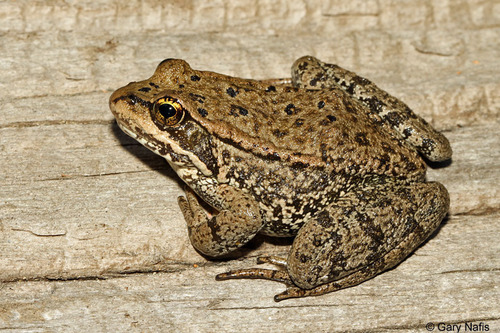
Cascades Frog
Rana cascadae
A hardy high-altitude specialist, the Cascades Frog is the iconic amphibian of the Pacific Northwest's subalpine meadows and volcanic peaks.
Quick Identification
Size
1.75 to 3 inches (4.4 to 7.5 cm) snout-to-vent length
Colors
Olive-green, tan, or copper-brown back with distinct ragged black spots; belly is typically honey-yellow to cream
Key Features
- Distinctive black spots with ragged or irregular edges
- Honey-yellow or cream-colored wash on the belly and undersides of legs
- Well-defined ridges (dorsolateral folds) running down the sides of the back
- Golden eyes with horizontal pupils
When You’ll See Them
Geographic range
Where Does the Cascades Frog Live?
Native to the Pacific Northwest of North America, the Cascades Frog is a regional specialist found almost exclusively in high-altitude corridors. Its range follows the volcanic spine of the Cascade Mountains from northern Washington through Oregon and into the Lassen Peak region of Northern California, with a separate disjunct population inhabiting the Olympic Mountains of Washington. This species is a true mountain resident, rarely venturing into the lowlands or far from the alpine snowmelt that feeds its habitat.
Basemap © OpenStreetMap contributors
Behavior
The Cascades Frog is a specialized mountain dweller that has adapted to the short, intense growing seasons of the Pacific Northwest's high elevations. Unlike many lowland frogs that are strictly nocturnal to avoid heat, these frogs are primarily diurnal. They spend a significant portion of their day basking on sun-warmed rocks or logs near the edges of snow-melt pools and subalpine meadows, using the sun's energy to regulate their metabolism.
These frogs are highly site-faithful, often returning to the same breeding ponds year after year as soon as the ice begins to thaw. They are excellent jumpers and are quite wary; at the slightest vibration or shadow, they will leap into deeper water and hide in the bottom silt. During the long winter months, they hibernate in the saturated mud of pond bottoms or in spring-fed subterranean cavities where the water does not freeze solid.
EverydayEarth exclusive
Camera Tips
Capturing the Cascades Frog on a trail camera requires finding 'relic' water—small pools or pond margins that remain wet through the heat of August. Position your camera very low to the ground, ideally 6 to 10 inches high, and angle it slightly downward toward a flat, sun-exposed rock or a half-submerged log. These are the preferred basking spots where frogs will sit motionless for hours, providing excellent opportunities for clear, high-resolution triggers.
Since these frogs are small and their movement can be subtle, use a camera with a high-sensitivity PIR (Passive Infrared) sensor and set it to take photo bursts or short 10-second videos. Because they are diurnal, you don't need to worry about heavy flash use, which can sometimes wash out their intricate spot patterns. Instead, look for locations with 'dappled' sunlight where the frog's olive-green skin will naturally contrast against the grey mountain stone.
Avoid placing cameras in fast-moving water; instead, focus on the quiet, silty 'bays' of subalpine lakes. If you are using an AI-powered camera like those from EverydayEarth, ensure the focal range is set for close-up subjects, as a frog sitting 3 feet away may appear too small for reliable identification. The best time to deploy cameras is mid-summer, just after the heavy snowpack has retreated and the meadows are in full bloom.
Similar Species
Species that look similar or are commonly confused with Cascades Frog.
Oregon Spotted Frog
Has a reddish-orange underside and eyes that are angled more upward than the Cascades Frog.
Columbia Spotted Frog
Typically has a redder belly and is found further inland toward the Rocky Mountains.
American Bullfrog
Much larger (up to 8 inches), lacks the ragged spots, and has a massive, circular eardrum (tympanum).
Frequently Asked Questions
Record Cascades Frog at your habitat
Connect a camera to start building your own species record — AI identifies every visitor automatically.