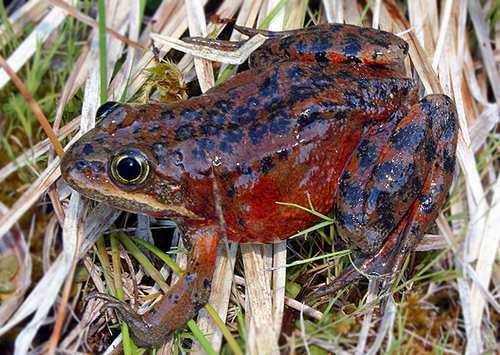
Oregon Spotted Frog
Rana pretiosa
Meet the Pacific Northwest's most dedicated water-dweller. With its striking red belly and upward-gazing eyes, the Oregon Spotted Frog is a rare and beautiful indicator of a healthy wetland ecosystem.
Quick Identification
Size
4.4 to 10 cm (1.7 to 4 inches) snout-to-vent length; weighing approximately 20 to 80 grams.
Colors
Olive-green to reddish-brown back with irregular, ragged black spots; undersides of hind legs and belly feature a distinctive red or orange wash in adults.
Key Features
- Gold-colored eyes angled upward rather than outward
- Ragged black spots with light centers on the back
- Fully webbed hind feet to the tip of the toes
- Red-orange wash on the underside of the belly and legs
When You’ll See Them
Behavior
The Oregon Spotted Frog is perhaps the most aquatic frog in the Pacific Northwest, rarely venturing far from a permanent water source. They are highly specialized for life in the shallows, often seen floating just below the surface with only their upward-tilted eyes exposed. Unlike many other frog species that migrate to upland forests after breeding, this species remains tied to the wetlands year-round, moving only between different depths of water as the seasons change.
During the winter, they enter a period of dormancy, tucking themselves into the silty bottoms of springs or oxygen-rich beaver ponds. They are social breeders, gathering in large communal groups during the early spring to lay their eggs in the shallowest, warmest parts of the marsh. While they are generally wary of humans and will dive into the mud at the slightest vibration, they can become quite focused during sun-basking sessions on floating vegetation.
EverydayEarth exclusive
Camera Tips
Because Oregon Spotted Frogs are almost entirely aquatic, camera placement is the most critical factor for success. You should position your camera extremely low to the ground, ideally just 2-5 inches above the water level on a stable bank or a sturdy, partially submerged log. Focus on areas with 'emergent vegetation' like rushes or sedges, as these frogs love to bask in the sun while remaining partially hidden by stalks. A downward angle of about 15-20 degrees toward a muddy shoreline or a flat lily pad will provide the best framing for a clear identification.
Capturing amphibians can be tricky for standard PIR (Passive Infrared) sensors because frogs are cold-blooded and don't always trigger heat-based sensors. To circumvent this, use your camera’s 'Time Lapse' mode set to an interval of one photo every 30-60 seconds during the peak sun hours of 10 AM to 4 PM. If your AI camera has a 'High Sensitivity' motion setting, enable it to catch the quick flick of their tongue or the ripple of water as they dive. These frogs are highly sensitive to vibration, so ensure your camera mount is rock-solid and avoid visiting the site daily to check the SD card.
The best time to deploy your gear is during the early spring breeding window (late February to April, depending on elevation). Look for shallow, flooded meadows where the water is only a few inches deep. This is where the frogs gather in high densities for communal egg-laying. In the summer, move your setup to deeper, more permanent pools where the frogs congregate as the seasonal wetlands dry up. Always ensure your camera housing is 100% waterproof, as water levels in these habitats can fluctuate rapidly after a heavy Pacific Northwest rain.
Similar Species
Species that look similar or are commonly confused with Oregon Spotted Frog.
Columbia Spotted Frog
Nearly identical but geographically separated; the Columbia species is found further east and north with slightly different mottling on the belly.
Northern Red-legged Frog
Has eyes that angle outward and longer back legs; its belly red is usually more translucent and it spends more time in forests than in water.
American Bullfrog
Much larger with a prominent circular eardrum (tympanum) and lacks the distinctive ragged black spots of the spotted frog.
Frequently Asked Questions
Record Oregon Spotted Frog at your habitat
Connect a camera to start building your own species record — AI identifies every visitor automatically.