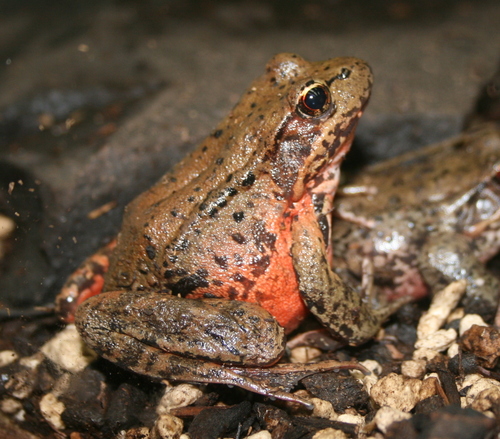
Northern Red-legged Frog
Rana aurora
A secretive gem of the Pacific Northwest, the Northern Red-legged Frog is a master of camouflage known for its striking crimson legs and quiet, forest-dwelling lifestyle.
Quick Identification
Size
5 to 13 cm (2 to 5.25 inches) from snout to vent; females are significantly larger than males.
Colors
Backs are olive to reddish-brown with small black flecks; the underside of the hind legs and lower belly feature a translucent, bright red wash; a dark 'mask' sits behind the eye.
Key Features
- Distinctive dark mask behind the eye with a light-colored jaw stripe
- Prominent skin ridges (dorsolateral folds) extending from the eye to the lower back
- Deep red coloration on the undersides of the hind legs
- Smooth, moist skin with small black spots across the back
When You’ll See Them
Behavior
The Northern Red-legged Frog is a shy, cryptic resident of the Pacific Northwest. Unlike many other frogs that remain near water year-round, these amphibians are highly terrestrial. Outside of the winter breeding season, they can be found wandering quite far into moist forests and damp garden corners, relying on their mottled brown skin to disappear into the leaf litter.
When they feel threatened, these frogs utilize a unique 'freeze' defense, staying perfectly still until the very last second before launching themselves away with powerful, erratic leaps. They are remarkably cold-tolerant, often beginning their migration to breeding ponds in the dead of winter during the first heavy rains of January. Because they call from underwater, you are much more likely to see them on camera than to hear their low-pitched, stuttering croaks.
EverydayEarth exclusive
Camera Tips
To successfully capture a Northern Red-legged Frog on your backyard camera, placement is the most critical factor. These frogs are ground-dwellers that prefer damp 'micro-climates.' Position your camera at an ultra-low angle, no more than 4 to 6 inches off the ground, and point it toward transition zones—places where a garden bed meets a lawn, or near the base of a rock wall or log pile. This low perspective ensures you can see the identifying red undersides of their legs and the distinctive mask that differentiates them from other species.
Since these frogs are primarily nocturnal and most active during the rainy season, you will need a camera with excellent infrared (IR) night vision and a very fast trigger speed. While they move slowly when foraging, they can exit the frame in a single leap if startled. If your camera has adjustable focus, set it for a close-range 'macro' distance (around 2-3 feet) to ensure the frog isn't just a blurry brown blob in the foreground. Using a high-sensitivity PIR (passive infrared) setting will help the camera detect the small heat signature of an amphibian against the cool ground.
You can 'bait' an area for these frogs by creating an inviting habitat rather than using food. Place a large, flat piece of bark or a ceramic 'toad house' in front of your camera to give them a place to hide. If the weather is dry, lightly watering the area in front of the lens just before sunset can create a localized humidity spike that draws them out of hiding. During the winter breeding migration (January–March), look for natural funnels like the space between a garden fence and a pond to place your camera for the best action shots.
Similar Species
Species that look similar or are commonly confused with Northern Red-legged Frog.
California Red-legged Frog
Found further south, this species is usually larger and has more prominent bumps or 'warts' on its back compared to the smoother Northern species.
American Bullfrog
Much larger with no ridges running down the back; they have a massive eardrum and lack the red coloration on the underside of the legs.
Cascades Frog
Identified by more distinct, ink-like black spots on the back and yellow-colored wash on the legs instead of red.
Frequently Asked Questions
Record Northern Red-legged Frog at your habitat
Connect a camera to start building your own species record — AI identifies every visitor automatically.