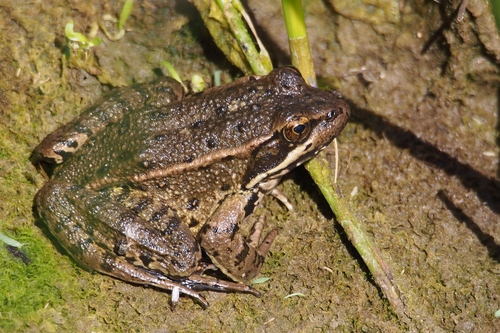
California Red-legged Frog
Rana draytonii
Once a staple of the Gold Rush era, this iconic California native is the largest frog in the West. Known for its incredible jumping ability and distinctive red legs, it is a master of the nighttime wetlands.
Quick Identification
Size
Adults range from 4.4 to 13 cm (1.75 to 5.25 inches) from snout to vent; females are significantly larger than males.
Colors
Olive, brownish, or reddish-brown skin with small black flecks; the underside of the hind legs and lower belly are a characteristic bright red or pinkish-red.
Key Features
- Prominent dorsolateral folds (ridges) running from behind the eyes to the hips
- Bright red or pinkish coloring on the underside of the belly and hind legs
- Dark mask or stripe extending through the eye to the shoulder
- Largest native frog in the Western United States
When You’ll See Them
Geographic range
Where Does the California Red-legged Frog Live?
This species is a Pacific Coast native, found almost exclusively within the state of California and extending slightly into northern Baja California, Mexico. While they once occupied the vast majority of the Central Valley and coastal ranges, their range is now restricted primarily to coastal areas from Marin County south to Ventura, with a few isolated populations remaining in the Sierra Nevada foothills.
Basemap © OpenStreetMap contributors
Behavior
The California Red-legged Frog is a primarily nocturnal amphibian with a shy and secretive nature. Famous as the likely inspiration for Mark Twain's 'The Celebrated Jumping Frog of Calaveras County,' these frogs are incredibly powerful jumpers, capable of leaping long distances to escape predators or ambush prey. During the day, they typically remain hidden in deep pools of water or thick riparian vegetation to stay cool and moist.
While they are highly aquatic, they are known for their surprising ability to travel over land. During rainy nights, individuals may migrate up to two miles between breeding ponds and non-breeding habitats, often seeking refuge in small mammal burrows or under damp leaf litter if they get caught in the open. They are solitary for most of the year but gather in the winter months for breeding, where males produce a soft, low-pitched grunting call that is often difficult for humans to hear from a distance.
EverydayEarth exclusive
Camera Tips
To successfully capture a California Red-legged Frog on camera, placement is everything. Position your device at the water's edge near a permanent pond or a slow-moving section of a creek. Look for 'haul-out' spots like flat rocks or partially submerged logs that provide a clear view of the water's surface. Because these frogs are strictly nocturnal, ensure your camera is equipped with no-glow infrared LEDs to prevent scaring them away with visible light.
Mount the camera very low to the ground—no higher than 6 to 12 inches—and angle it slightly downward toward the mudbank. These frogs are cold-blooded, which means their body temperature often matches the environment, sometimes making it difficult for standard PIR (Passive Infrared) motion sensors to trigger. To counter this, use a camera with high sensitivity settings or set a 'Time Lapse' mode to take a photo every 1-5 minutes during the first few hours after sunset.
Seasonal timing is critical. The best footage is often captured during the first heavy rains of autumn (usually November) when the frogs begin migrating toward breeding pools. During these wet nights, they are far more likely to cross paths with a camera positioned on a trail or near a drainage pipe. Avoid using any lures or baits, as this is a protected species; instead, focus on natural bottlenecks in vegetation where a frog is forced to travel through a narrow opening to reach the water.
Similar Species
Species that look similar or are commonly confused with California Red-legged Frog.
Northern Red-legged Frog
Very similar but generally smaller with smoother skin; found from Northern California up through British Columbia.
American Bullfrog
Much larger with a ridge that wraps around the ear rather than running down the back; lacks the red leg coloring.
Sierra Nevada Yellow-legged Frog
Found at much higher elevations in the mountains and features yellow or orange leg undersides instead of red.
Frequently Asked Questions
Record California Red-legged Frog at your habitat
Connect a camera to start building your own species record — AI identifies every visitor automatically.