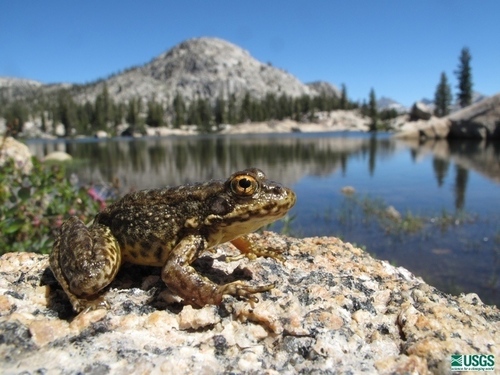
Sierra Nevada Yellow-legged Frog
Rana sierrae
A resilient inhabitant of the high-altitude wilderness, the Sierra Nevada Yellow-legged Frog is a master of the alpine thaw. Once the most common frog in the mountains, it is now a rare prize for wildlife observers and a symbol of Sierra conservation.
Quick Identification
Size
1.5 to 3.25 inches (3.8 to 8.3 cm) in length; they are small to medium-sized frogs.
Colors
Mix of olive, brown, or yellowish-brown upper bodies with dark spots or lichen-like mottling; the undersides of the hind legs and belly are a vibrant yellow or pale orange.
Key Features
- Bright yellow or orange pigmentation on the belly and inner thighs
- Rough, granular skin with dark 'ink blot' spotting
- Absence of vocal sacs, making their calls very quiet
- Fully webbed toes for an almost entirely aquatic lifestyle
When You’ll See Them
Behavior
The Sierra Nevada Yellow-legged Frog is one of the most aquatic frogs in North America, rarely venturing more than a few feet from the water's edge. Unlike many other amphibians that migrate to meadows, these frogs spend their entire lives in or near high-elevation lakes, ponds, and streams. They are famous for their basking behavior, often found perched on sunny granite rocks or logs during the heat of the day to regulate their body temperature in the chilly alpine air.
Socially, these frogs are relatively quiet and less territorial than their lowland cousins. Because they lack vocal sacs, they don't produce the loud 'ribbit' common to other frogs; instead, they emit a low, grating whistle or a soft clicking sound underwater. They are survivors of the extreme, capable of overwintering at the bottom of frozen lakes for up to nine months of the year, entering a state of dormancy until the spring thaw.
EverydayEarth exclusive
Camera Tips
Capturing the Sierra Nevada Yellow-legged Frog on camera requires a strategy focused on basking sites rather than transit trails. These frogs are cold-blooded and rely on the high-altitude sun to warm up. Look for flat, sun-exposed granite rocks that sit directly at the water’s edge or partially submerged logs. Set your camera at a very low angle, ideally no more than 6 inches off the ground, to capture their profile against the water. This perspective emphasizes their unique yellow undersides which are otherwise hidden when they sit flat.
Standard PIR (Passive Infrared) sensors on trail cameras often struggle to detect amphibians because frogs are close to the ambient temperature of their surroundings. To combat this, use a 'Time Lapse' or 'Field Scan' mode. Set the camera to take an image every 1-2 minutes during the peak sunlight hours of 10 AM to 4 PM. This ensures you catch them while they are stationary and soaking up UV rays, even if they aren't moving enough to trigger a traditional motion sensor.
Macro lenses or cameras with a short focal distance are highly recommended, as these frogs are small and blend in perfectly with lichen-covered rocks. Position the camera between 2 and 4 feet from the target basking spot. Because this species is federally endangered and highly sensitive to the chytrid fungus, it is vital to never handle the frogs or move rocks to place your camera. Always disinfect your boots and camera tripod legs with a 10% bleach solution before and after visiting alpine watersheds to prevent the spread of pathogens between sensitive habitats.
Similar Species
Species that look similar or are commonly confused with Sierra Nevada Yellow-legged Frog.
Frequently Asked Questions
Record Sierra Nevada Yellow-legged Frog at your habitat
Connect a camera to start building your own species record — AI identifies every visitor automatically.