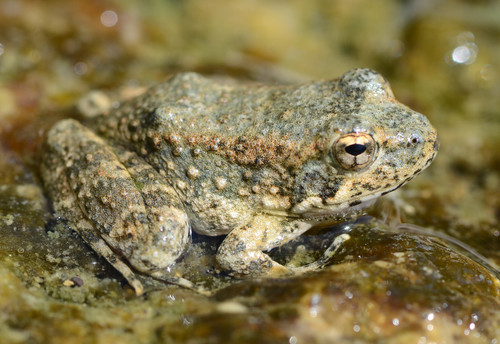
Foothill Yellow-legged Frog
Rana boylii
A master of camouflage and a sentinel of clean western waterways, the Foothill Yellow-legged Frog is the ultimate river-dweller. With skin that mimics river stone and a splash of yellow 'socks,' this rare amphibian is a prize for any backyard explorer with a nearby creek.
Quick Identification
Size
1.5 to 3 inches (3.7 to 7.5 cm) in length
Colors
Mottled gray, olive, or brown skin mimicking river stones; undersides of hind legs and lower belly have a distinctive pale yellow to bright lemon wash.
Key Features
- Sandpaper-textured grainy skin
- Yellow coloration on the underside of hind legs
- Lack of prominent ridges (dorsolateral folds) along the back
- Small, dark spotting that looks like water-worn pebbles
When You’ll See Them
Behavior
The Foothill Yellow-legged Frog is a specialized stream-dweller that has evolved to thrive in moving water. Unlike many common backyard frogs that prefer the still waters of ponds or marshes, this species is almost always found near rocky creek beds and flowing rivers. They are masters of camouflage, often sitting perfectly still on sun-warmed rocks where their mottled skin makes them nearly invisible against the mineral patterns of the stone.
When threatened, these frogs utilize a unique escape strategy: rather than jumping into tall grass, they leap directly into the swiftest part of the current and dive to the bottom, hiding among the cobbles. They are relatively solitary and quiet, producing a low-pitched, grating vocalization that is often lost to human ears amidst the sound of bubbling water. Their life cycle is intrinsically tied to the flow of the river, with breeding timed specifically to the receding waters of late spring.
EverydayEarth exclusive
Camera Tips
To capture high-quality images of the Foothill Yellow-legged Frog, you must think like a fly-fisherman. These frogs spend the majority of their daylight hours basking on flat rocks that jut out of the water or sit along the immediate shoreline. Position your camera on a low-profile tripod or a weighted beanbag mount just a few inches above the stream level. Aim your lens at 'basking platforms'—prominent, sun-exposed stones in the middle of the creek—as these are the prime real estate for frogs regulating their body temperature.
Because these frogs are small and blend in perfectly with their environment, use a camera with a high-resolution sensor and a fast trigger speed. Burst mode is your best friend here; the subtle movement of the frog's throat as it breathes or the split-second it takes to snap at a passing fly are the moments that make a photo stand out. If your camera supports it, high-definition video is often better than stills, as it allows you to distinguish the frog from the rocks once it moves. Avoid using heavy flashes, as the natural midday sun provides the best lighting to highlight the 'sandpaper' texture of their skin and the yellow tint on their legs.
Environmental protection is critical when filming this species. Use a waterproof housing or a weather-sealed camera, as the 'splash zone' of a mountain stream is naturally humid and prone to sudden sprays. Place your equipment during the morning and leave it for several hours to allow the frogs to become comfortable with the new object in their territory. Most importantly, stay on the bank and avoid wading through the water as much as possible to protect the fragile egg masses that are often attached to the downstream side of rocks during the spring and summer months.
Similar Species
Species that look similar or are commonly confused with Foothill Yellow-legged Frog.
Sierra Nevada Yellow-legged Frog
Found at much higher elevations in alpine lakes; has a slightly different call and more spotting on the belly.
American Bullfrog
Much larger with smooth skin and a massive, visible eardrum; usually found in still water rather than fast streams.
California Red-legged Frog
Has distinct ridges (dorsolateral folds) running down its back and red coloration on the undersides of legs instead of yellow.
Frequently Asked Questions
Record Foothill Yellow-legged Frog at your habitat
Connect a camera to start building your own species record — AI identifies every visitor automatically.