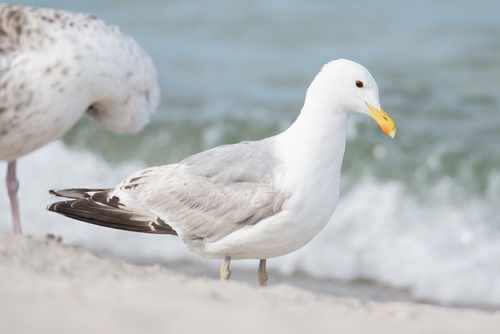
Caspian Gull
Larus cachinnans
With its elegant, elongated profile and 'laughing' call, the Caspian Gull is a master of the Eurasian waterways. Once a hidden gem of the eastern steppes, this intelligent bird is now a frequent and fascinating visitor to backyards and coastlines across Europe.
Quick Identification
Size
Length 22-27 inches (56-68 cm), wingspan 54-61 inches (137-155 cm), weight 1.5-3.3 lbs (680-1,500 g)
Colors
Adults have pale gray upperparts and white underparts. They feature black wingtips with very small white mirrors. Legs are typically pale yellow or flesh-colored, and the eyes are usually dark.
Key Features
- Long, slender 'snout-like' bill
- Beady, dark iris on a pear-shaped head
- Long, stilt-like legs
- Shallow, sloping forehead profile
When You’ll See Them
Geographic range
Where Does the Caspian Gull Live?
Native to the vast steppe regions of Central Asia and the basins of the Black and Caspian Seas, the Caspian Gull has undergone a significant westward expansion in recent decades. It is now a common sight across Central and Eastern Europe, with core populations in Russia, Ukraine, and Poland, while increasingly appearing as a regular winter visitor as far west as the British Isles and the North Sea coast. This adaptable species thrives along major river corridors and has successfully integrated into the urban fabric of many European cities.
Basemap © OpenStreetMap contributors
Behavior
Caspian Gulls are highly intelligent and opportunistic birds, known for their aggressive yet cautious nature. They are social creatures, often gathering in large, mixed-species flocks near water or abundant food sources like landfills and fishing ports. Despite their social nature, they maintain a distinctive 'stretching' posture and a more elegant, elongated silhouette compared to their bulkier cousins.
In human-dominated landscapes, these gulls have become expert scavengers. While they traditionally nested on sandy islets or steppe lakes, they are increasingly colonizing urban environments, even nesting on flat rooftops. They are vocal birds, using a loud, rhythmic 'laughing' call to defend territory or signal the discovery of food, a trait that earned them their scientific name 'cachinnans'.
EverydayEarth exclusive
Camera Tips
Capturing the Caspian Gull on a backyard or trail camera requires focusing on open ground or elevated flat surfaces near water. If your property is near a river or coast, place your camera on a low tripod or a stable mount facing a large, shallow birdbath or a flat patch of lawn. Because these gulls have long legs and a distinctive 'snouty' head shape, a low-angle shot (about 12-18 inches off the ground) provides the best profile for identification against similar-looking species like the Herring Gull.
For lure suggestions, these birds are highly attracted to protein. While they are scavengers, avoid messy household scraps; instead, use high-quality dried mealworms or small pieces of raw fish placed in a flat, heavy ceramic tray to prevent the wind or the bird from dragging it out of the frame. Position the 'landing zone' approximately 8 to 12 feet from the camera lens to ensure the bird's large wingspan is captured as it approaches or takes off.
Lighting is the most critical factor for identifying the Caspian Gull’s subtle features, such as the dark, beady iris and the specific shade of the gray mantle. Set your camera to face away from the sun (north-facing in the Northern Hemisphere) to avoid 'white-out' on their bright plumage. High-speed shutter settings or 'Burst Mode' are essential, as gulls are quick and jerky in their movements. Early morning light is particularly effective at highlighting the leg color and bill shape without the harsh glare found at midday.
Similar Species
Species that look similar or are commonly confused with Caspian Gull.
Frequently Asked Questions
Record Caspian Gull at your habitat
Connect a camera to start building your own species record — AI identifies every visitor automatically.