Yellow-legged Gull
Larus michahellis
Master of the Mediterranean coast and a bold urban explorer, the Yellow-legged Gull is a striking seabird famous for its piercing gaze and golden limbs.
Quick Identification
Size
Length: 52–68 cm (20–27 in); Wingspan: 120–155 cm (47–61 in); Weight: 550–1,600 g (1.2–3.5 lbs)
Colors
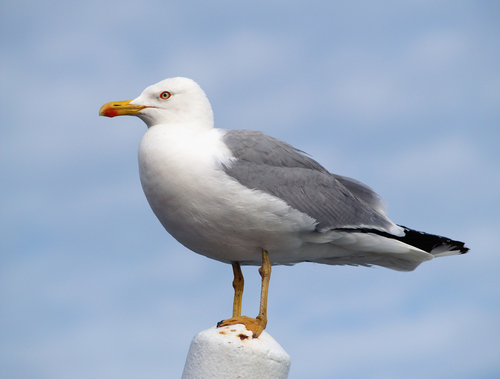
Adults have white heads and underparts with a medium-grey mantle and wings. They are characterized by bright yellow legs and a yellow bill with a red spot on the lower mandible.
Key Features
- Bright yellow legs in mature adults
- Medium-grey mantle, darker than a Herring Gull but lighter than a Lesser Black-backed Gull
- Red ring (orbital ring) around the eye
- Large, powerful bill with a prominent red spot near the tip
- White 'mirrors' on black wingtips
When You’ll See Them
Geographic range
Where Does the Yellow-legged Gull Live?
The Yellow-legged Gull is a quintessential Mediterranean species, native to the coastlines and islands of Southern Europe, North Africa, and the Middle East. Over the last several decades, it has expanded its range significantly, moving north along major river systems into Central and Western Europe, including the United Kingdom, France, and Germany. Today, it is a common sight from the Atlantic coast of Portugal to the Black Sea, thriving in both traditional maritime habitats and modern metropolitan centers.
Basemap © OpenStreetMap contributors
Behavior
The Yellow-legged Gull is a highly intelligent and opportunistic bird, known for its bold personality and remarkable adaptability to human environments. While they were historically confined to rocky coastal cliffs and islands, they have increasingly moved into urban areas, where they are often seen nesting on rooftops and patrolling city squares. They are social birds, frequently seen in large, noisy colonies during the breeding season, but they are also fiercely territorial when it comes to protecting their nest sites.
In their interactions with humans, they are often perceived as daring, frequently scavenging for food in outdoor cafes or landfills. Their vocalizations are loud and varied, featuring a deep, 'laughing' call that is a signature sound of Mediterranean coastlines. Despite their reputation as scavengers, they are also skilled hunters, capable of catching fish at sea or even preying on smaller birds and rodents in urban parks.
EverydayEarth exclusive
Camera Tips
To capture the best footage of Yellow-legged Gulls, camera placement is everything. If you live in an urban or suburban area where these gulls are active, rooftop placements are significantly more effective than ground-level setups. Secure your camera to a chimney stack or a weighted tripod on a flat roof, angling it toward a known resting spot or a shallow water basin. Because these gulls have excellent vision, ensure your camera is well-secured; they have been known to peck at or even attempt to move small, unsecured objects.
Lighting is crucial for identifying this species, as the yellow of their legs and the specific shade of their grey mantle are key identifiers. Aim for early morning or late afternoon sun, which highlights the red orbital ring around the eye and the red spot on the bill. Set your camera’s trigger speed to its fastest setting—Yellow-legged Gulls are quick to land and take off, and you’ll want to catch the moment they spread their wings to see the black-and-white 'mirror' patterns on the tips.
While baiting is common in some bird photography, gulls can become aggressive or nuisance-like if fed regularly. Instead, a large, shallow birdbath or a steady source of clean water is a better 'lure' for capturing natural bathing and preening behaviors. During the winter months, these gulls are often more willing to investigate new objects, so this is a great time to experiment with camera angles. Use a wide-angle lens if possible to capture their impressive wingspan as they approach.
Similar Species
Species that look similar or are commonly confused with Yellow-legged Gull.
European Herring Gull
Herring Gulls have pink legs rather than yellow, and a noticeably paler grey mantle.
Caspian Gull
Caspian Gulls have a more 'pear-shaped' head, smaller eyes, and longer, thinner bills.
Lesser Black-backed Gull
This species also has yellow legs but features a much darker, slate-grey to blackish mantle.
Frequently Asked Questions
Record Yellow-legged Gull at your habitat
Connect a camera to start building your own species record — AI identifies every visitor automatically.