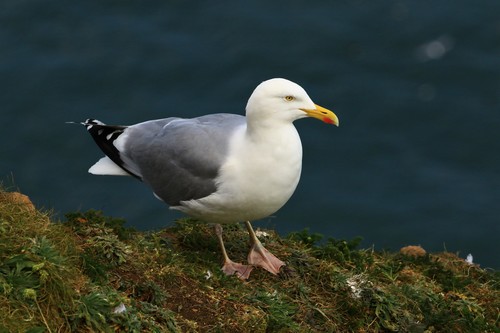
European Herring Gull
Larus argentatus
The European Herring Gull is a master of adaptation, equally at home on a wild Atlantic cliff as it is on a suburban rooftop. Known for its piercing yellow eyes and impressive intelligence, this bird is the quintessential sound of the seaside.
Quick Identification
Size
Length: 55–67 cm (22–26 in); Wingspan: 125–155 cm (49–61 in); Weight: 710–1,500 g (1.6–3.3 lbs)
Colors
Adults feature a pale grey mantle (back) and wings, white head and underparts, and black wingtips with white spots. They have pink legs and a yellow bill with a red spot. Juveniles are mottled brown and grey.
Key Features
- Pale grey mantle with black-and-white wingtips
- Bright pink legs and feet
- Yellow bill with a prominent red spot on the lower mandible
- Large, powerful build with a pale yellow iris
When You’ll See Them
Geographic range
Where Does the European Herring Gull Live?
Native to the northern and western reaches of Europe, the European Herring Gull is most commonly found along the Atlantic, North Sea, and Baltic coasts. Its core range spans from the British Isles and northern France up through Scandinavia and into Arctic Russia. While many populations remain resident year-round in temperate zones, those in the furthest northern regions are migratory, moving south toward the coastlines of Western Europe during the winter.
Basemap © OpenStreetMap contributors
Behavior
European Herring Gulls are highly intelligent, social, and remarkably adaptable birds. They possess a complex communication system consisting of various calls and body postures, most notably the 'long call' used to signal territory. While they are famous for their colonial nesting on coastal cliffs, they have successfully moved into urban environments, where they often nest on flat rooftops to stay safe from ground predators like foxes.
These gulls exhibit high levels of problem-solving ability. They have been observed dropping hard-shelled mollusks onto rocks or pavement from a height to break them open, and some individuals even follow fishing boats or learn the specific schedules of outdoor markets. In suburban settings, they are bold and observant, often watching human activity to identify easy opportunities for a meal.
EverydayEarth exclusive
Camera Tips
To successfully capture a European Herring Gull on your backyard camera, you need to think about elevation. These birds prefer high vantage points for scouting, so placing your camera on a flat roof, a high deck railing, or a balcony is often more productive than a ground-level setup. If you are mounting the camera high, angle it slightly downward (about 15-20 degrees) to capture the bird as it lands and inspects the area.
If you prefer ground-level shots, ensure your camera is extremely secure. Herring Gulls are famously curious and have powerful bills; they are known to peck at or even try to flip over unfastened equipment. Use a heavy-duty tripod or a screw-in mount. For baiting, high-protein items like fish scraps or even a bowl of water can be very effective, especially during hot summer days when fresh water is at a premium in coastal or urban environments.
Since these gulls are most active during daylight hours, optimize your camera settings for daytime triggers to save battery. Use a fast trigger speed (0.2s to 0.5s) and a multi-shot burst mode if available, as gulls are incredibly quick when they take off or swoop down for food. Early morning light often provides the best detail for their pale grey plumage, preventing the white areas from appearing 'blown out' or overexposed in the midday sun.
Similar Species
Species that look similar or are commonly confused with European Herring Gull.
Lesser Black-backed Gull
Look for bright yellow legs and a much darker grey/black mantle compared to the Herring Gull's pink legs and pale grey back.
Common Gull
Smaller overall with a more 'gentle' expression, a thinner bill without a red spot, and greenish-yellow legs.
Caspian Gull
Has longer legs, a smaller eye that looks like a dark bead, and a more elongated, 'pear-shaped' head profile.
Frequently Asked Questions
Record European Herring Gull at your habitat
Connect a camera to start building your own species record — AI identifies every visitor automatically.