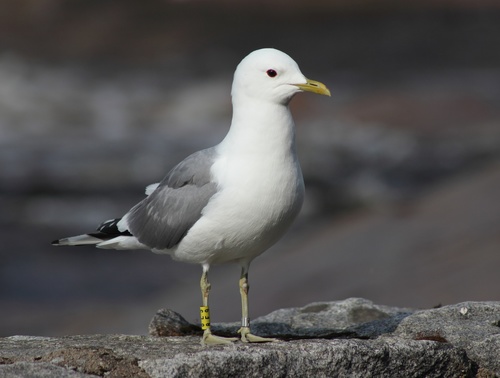
Common Gull
Larus canus
Elegant, intelligent, and deceptively gentle-looking, the Common Gull is a master of adaptation. From coastal cliffs to suburban schoolyards, this pearl-grey voyager is a fascinating addition to any backyard camera setup.
Quick Identification
Size
Length 40–46 cm (16–18 in), wingspan 100–115 cm (39–45 in), weight 300–600 g (11–21 oz)
Colors
Adults have a pearl-grey back and wings with black wingtips featuring white spots; white head and underparts; greenish-yellow legs and bill. Juveniles are mottled brown and grey.
Key Features
- Slender, greenish-yellow bill without a red spot
- Dark, 'kind' looking eyes compared to larger gulls
- Yellow-green legs in adults
- Significant white 'mirrors' on black wingtips
When You’ll See Them
Geographic range
Where Does the Common Gull Live?
The Common Gull is a widespread resident of the Palearctic, with its native range stretching from the rocky coasts of Iceland and the British Isles across Northern Europe and Siberia to the Kamchatka Peninsula. While many populations in Western Europe are resident year-round, birds from colder inland regions migrate south during the winter, reaching as far as the Mediterranean, the Persian Gulf, and the coastal regions of China and Japan. They are a common sight in urban and suburban environments throughout Northern Europe and Asia, particularly during the winter months.
Basemap © OpenStreetMap contributors
Behavior
The Common Gull is a highly social and intelligent bird, often seen in large, noisy flocks alongside other gull species. Despite their name, they are frequently found far inland, showing a remarkable ability to adapt to human-altered landscapes. They are famous for their 'foot-paddling' behavior, where they rapidly tap their feet on wet grass to mimic the vibrations of rain, tricking earthworms into emerging at the surface.
While they are less aggressive toward humans than the larger Herring Gulls, they are opportunistic scavengers and quick to learn where food can be found. They are often seen following tractors in agricultural fields to pick up disturbed invertebrates or visiting school playgrounds and parks during lunch hours. During the breeding season, they nest in colonies, usually near water, but increasingly on the flat gravel roofs of suburban buildings.
EverydayEarth exclusive
Camera Tips
To capture the best footage of Common Gulls on your backyard or trail camera, focus on open lawn areas rather than dense vegetation. These birds prefer clear sightlines where they can spot predators. Placing your camera 12–18 inches off the ground, angled slightly upward, will help you capture their unique 'foot-paddling' behavior. If you have a birdbath or a shallow water feature, this is a prime location for placement, as gulls are frequent and vigorous bathers.
For baiting in a backyard setting, scattered mealworms or small amounts of soaked dog kibble can attract them, though you should check local regulations regarding feeding wildlife. They are most active in the early morning and late afternoon when light is soft, so ensure your camera's ISO settings are optimized for these 'golden hours' to avoid grainy footage. If your camera has a 'burst' or 'photo-to-video' mode, use it to capture the fast motion of their wings during takeoff and landing.
During the winter, Common Gulls often congregate in larger numbers in suburban gardens, especially after a heavy rain. If you live near a school or park, positioning your camera near a flat garage roof can offer a unique perspective, as they often use these high points as lookout posts. Set your trigger speed to the fastest possible setting; gulls are quick and can easily fly in and out of the frame before a slow camera reacts.
Similar Species
Species that look similar or are commonly confused with Common Gull.
Frequently Asked Questions
Record Common Gull at your habitat
Connect a camera to start building your own species record — AI identifies every visitor automatically.