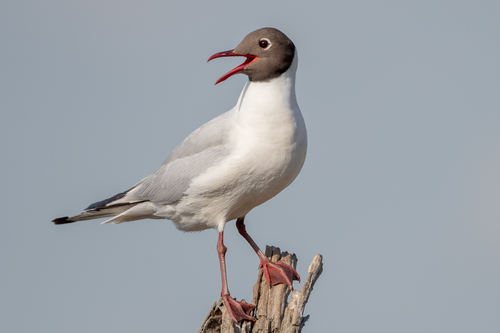
Black-headed Gull
Chroicocephalus ridibundus
The Black-headed Gull is a lively and charismatic visitor that brings a touch of coastal energy to inland gardens and parks. Famous for its chocolate-brown summer mask and its clever 'dancing' for worms, this adaptable bird is a favorite for backyard birdwatchers.
Quick Identification
Size
Length: 37–44 cm (14.5–17.3 in); Wingspan: 94–110 cm (37–43 in); Weight: 190–400 g (6.7–14.1 oz)
Colors
White body with pale grey wings and black primary tips. Summer adults feature a dark chocolate-brown hood (often appearing black from a distance) and dark red bills and legs. Winter adults lose the hood, retaining only a small dark 'ear' spot behind the eye.
Key Features
- Chocolate-brown facial hood in breeding plumage
- Distinctive dark ear spot in winter plumage
- Slender, dark red bill and legs
- White leading edge on the outer wing visible in flight
When You’ll See Them
Geographic range
Where Does the Black-headed Gull Live?
The Black-headed Gull is native across the vast Palearctic region, spanning from Iceland and the British Isles across Europe and Central Asia to the coasts of China and Japan. While populations in the milder climates of Western Europe and the Mediterranean are often year-round residents, those breeding in colder northern latitudes migrate south to Africa and Southern Asia for the winter. In North America, they have established a small but persistent breeding population in Eastern Canada and are increasingly common winter visitors along the Atlantic coast of the United States.
Basemap © OpenStreetMap contributors
Behavior
These birds communicate through a complex series of raucous calls and visual displays. They are bold when searching for food but maintain a level of wariness toward humans unless they are in areas where they are frequently fed. In the winter, they often form large communal roosts on lakes or reservoirs, sometimes numbering in the tens of thousands, which helps them stay safe from predators and share information about food sources.
EverydayEarth exclusive
Camera Tips
To capture the best footage of Black-headed Gulls, position your AI camera at a low angle, roughly 1 to 2 feet off the ground, near a flat open space like a garden lawn or a lakeside dock. These birds are ground-feeders and are much more comfortable landing in open areas where they have a clear 360-degree view to watch for predators. If you have a backyard pond or a large birdbath, aiming the camera at the water's edge is highly effective, as they are frequent bathers and spend significant time preening their feathers after a dip.
While gulls are often associated with bread, it is better for their health—and your photo quality—to use high-protein lures like dried mealworms or small bits of suet scattered on the grass. Because they are highly social, the arrival of one bird often triggers a 'landing party' of several others, creating dynamic scenes of social interaction. Set your camera to a short video trigger (10-15 seconds) or a high-speed burst mode to catch their quick movements and the interesting 'foot-paddling' behavior they use to find worms.
Lighting is crucial for these birds because of their pale plumage. The early morning or late afternoon sun provides a soft light that won't wash out the white feathers. During winter, when the birds lose their dark hoods, you may need to increase your camera's exposure compensation by +0.5 if you are shooting against a bright or snowy background, ensuring the detail in their white and grey feathers is preserved rather than appearing as a solid white mass.
Similar Species
Species that look similar or are commonly confused with Black-headed Gull.
Common Gull
Larger with a greenish-yellow bill and legs, lacking the chocolate-brown hood or the dark ear spot.
Bonaparte's Gull
A smaller North American relative with a black bill and a true black (not brown) hood during the breeding season.
Mediterranean Gull
Has a jet-black hood that extends further down the neck and lacks black on the wingtips, appearing much whiter in flight.
Frequently Asked Questions
Record Black-headed Gull at your habitat
Connect a camera to start building your own species record — AI identifies every visitor automatically.