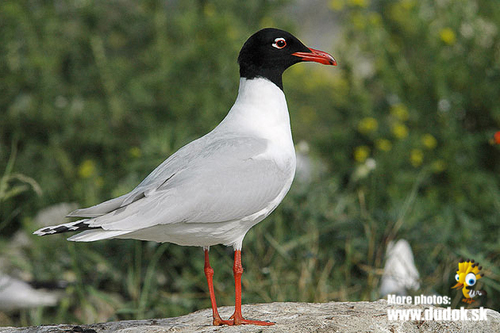
Mediterranean Gull
Ichthyaetus melanocephalus
With its velvet-black hood and snow-white wingtips, the Mediterranean Gull is the most sophisticated-looking visitor to the European coastline. Once a rare southern treat, this 'Med Gull' is now a star of suburban parks and coastal gardens alike.
Quick Identification
Size
Length: 36–38 cm (14–15 in); Wingspan: 92–105 cm (36–41 in); Weight: 230–350 g (8–12 oz)
Colors
Adults in breeding plumage feature a jet-black hood, white eye crescents, and a bright red bill. Their wings are a very pale grey with strikingly pure white tips.
Key Features
- Full jet-black hood extending down the nape
- Pure white primary wing feathers with no black markings
- Thick, drooping bright red bill with a dark band
- White eye-ring crescents visible against the black hood
When You’ll See Them
Geographic range
Where Does the Mediterranean Gull Live?
Native to the Mediterranean and Black Sea regions, this elegant gull has staged a remarkable expansion across Europe over the last several decades. It is now a common breeding bird and year-round resident along the coasts of the United Kingdom, France, Germany, and the Low Countries. While its heartland remains in southeastern Europe, specifically Ukraine and Russia, the species is now firmly established as a fixture of Western European shorelines and inland waterways.
Basemap © OpenStreetMap contributors
Behavior
The Mediterranean Gull is a highly social bird, often found nesting within large colonies of other gull species, particularly Black-headed Gulls. Despite their social nature, they are distinctively quieter and less aggressive than the larger 'larus' gulls. They have a characteristic 'mewing' call that sounds more nasal and mournful than the raucous cries of a Herring Gull.
While they are traditionally coastal birds, they have become increasingly adept at utilizing inland resources. You will often see them following tractors in agricultural fields to pick up disturbed invertebrates or visiting suburban parks and school playing fields. Unlike many gulls that scavenge heavily at landfills, the Mediterranean Gull maintains a preference for 'cleaner' foraging, focusing on insects and small aquatic prey.
EverydayEarth exclusive
Camera Tips
To capture the Mediterranean Gull on a backyard camera, placement is everything. If you live near the coast or a large inland body of water, focus your camera on flat, open areas like a manicured lawn or a flat rooftop. These birds are less likely to visit a hanging feeder and much more likely to be caught foraging on the ground for worms or insects after a rainstorm.
One of the best ways to lure this species into your camera's frame is by providing a wide, shallow water source. A large ground-level birdbath or a shallow pond edge is irresistible to them for both drinking and bathing. Because they have very white plumage, set your camera's exposure compensation slightly lower (EV -0.5 or -1.0) if possible; this prevents the bright white wings from 'blowing out' and losing detail in direct sunlight.
Timing is crucial for capturing their most stunning look. Set your camera to be most active during the spring months (March through May) when the adults display their full, velvet-black hoods. During the winter, they lose the hood and sport a dark smudge behind the eye, making them harder to distinguish from other gulls at a distance. If using a trail camera, a high-speed 'burst' mode is recommended to capture the elegance of their white primary feathers during takeoff.
Similar Species
Species that look similar or are commonly confused with Mediterranean Gull.
Black-headed Gull
Has a dark chocolate-brown hood rather than jet-black, and visible black tips on the outer primary feathers.
Common Gull
Lacks the black hood in summer and has prominent black-and-white 'mirrors' on the wingtips.
Laughing Gull
A North American relative with much darker grey upperparts and black wingtips.
Frequently Asked Questions
Record Mediterranean Gull at your habitat
Connect a camera to start building your own species record — AI identifies every visitor automatically.