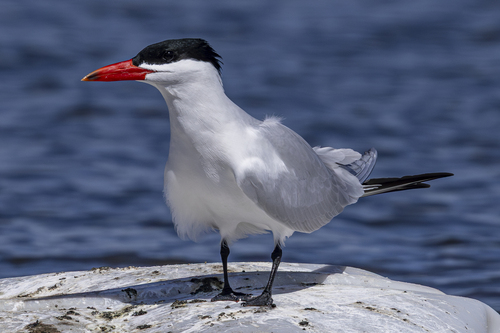
Caspian Tern
Hydroprogne caspia
Meet the undisputed heavyweight champion of the tern world, a striking bird with a massive red bill and a voice that demands attention. Whether patrolling coastal shorelines or massive inland lakes, the Caspian Tern is a master of the high-dive.
Quick Identification
Size
Length: 48–60 cm (19–24 in); Wingspan: 127–145 cm (50–57 in); Weight: 530–780 g (1.1–1.7 lbs)
Colors
White body and neck with pale gray wings; a prominent jet-black cap during breeding (streaked white in winter); massive, bright carrot-red bill with a dark tip.
Key Features
- Massive, thick red-orange bill with a small black tip
- Largest tern in the world, similar in size to a Herring Gull
- Velvety black cap that extends just below the eye
- Deep, raspy 'kraaa' call unlike higher-pitched terns
When You’ll See Them
Geographic range
Where Does the Caspian Tern Live?
Caspian Terns are truly global citizens, native to every continent except South America and Antarctica. In North America, they breed across the Canadian interior and along both the Atlantic and Pacific coasts, while in the Eastern Hemisphere, significant populations thrive across Eurasia, Africa, and Australia. Despite their massive range, they are surprisingly selective, often appearing in scattered pockets where large bodies of water provide reliable fishing and secluded sandy islands offer safe nesting sites.
Basemap © OpenStreetMap contributors
Behavior
The Caspian Tern is a bold and commanding presence in the avian world, often described as a 'gull in tern's clothing' due to its sheer size and aggressive nature. Unlike many of its smaller, more delicate cousins, the Caspian Tern is highly territorial, particularly near nesting colonies where it will not hesitate to dive-bomb intruders—including humans. They are social birds that often congregate in large colonies, yet they remain fiercely individualistic when it than comes to protecting their specific nesting scrape in the sand.
These birds are master aerialists with a specialized hunting style. You will often see them patrolling about 30 to 60 feet above the water, bill pointed downward, scanning for movement. When they spot a target, they perform a spectacular vertical plunge, often disappearing completely beneath the surface for a moment before emerging with a fish. In suburban settings near large lakes or coasts, they are often heard before they are seen, emitting a loud, harsh, rasping croak that can be heard from over a mile away.
EverydayEarth exclusive
Camera Tips
To capture the Caspian Tern on a backyard or shoreline camera, placement is everything. If you live near a large lake or coastal waterway, aim your camera toward flat, open areas such as private docks, piers, or sandy spits. These birds love elevated perches with a clear view of the water. Setting your camera between 3 and 5 feet off the ground, angled slightly upward to catch them as they land on a railing or post, provides the most dramatic profile shots of their massive red bills.
Since these birds are exceptionally fast during their hunting dives, use a camera with a high-speed motion trigger and a fast shutter speed if possible. If your AI camera allows for 'Zone Triggering,' set the zone to focus on the edge of a dock or a specific rock where birds might rest to preen. They are most active during the mid-morning and late afternoon when fish are closer to the surface, so ensure your camera is positioned to avoid direct lens flare during these golden hours.
While you shouldn't use food to lure them—as they only hunt live fish—you can attract them by providing a stable, flat resting spot. A simple wooden platform or a floating raft in a quiet cove can become a favorite resting spot for a Caspian Tern. Because they are large birds, ensure the camera has a wide enough field of view; otherwise, you might end up with a high-resolution photo of just a wing or a tail as they take off.
Similar Species
Species that look similar or are commonly confused with Caspian Tern.
Frequently Asked Questions
Record Caspian Tern at your habitat
Connect a camera to start building your own species record — AI identifies every visitor automatically.