Royal Tern
Thalasseus maximus
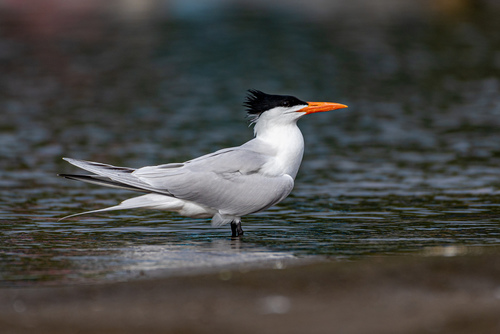
The Royal Tern is the crowning jewel of the coastline, instantly recognizable by its fiery orange bill and punk-rock shaggy crest. These master divers bring a splash of regal energy to any seaside backyard.
Quick Identification
Size
Length: 18-21 in (45-53 cm); Wingspan: 41-43 in (105-110 cm); Weight: 12-16 oz (350-450 g)
Colors
Pale gray wings and back with bright white underparts; striking orange or reddish-orange bill; black legs and a black cap that thins to a shaggy crest in winter.
Key Features
- Large, thick orange-to-red bill
- Shaggy black crest at the back of the head
- Deeply forked tail
- Pale gray upperparts with white forehead in winter
When You’ll See Them
Behavior
Royal Terns are charismatic and highly social seabirds, often seen in large, noisy groups along the coast. They are famous for their dramatic foraging style, which involves flying at heights of 30 feet or more before performing a steep, vertical plunge-dive into the water to snag small fish. Unlike some gulls, they rarely scavenge on land, preferring the fresh catch of the sea.
These birds are exceptionally vocal, frequently emitting a loud, rasping 'keer-reet' call that can be heard over the sound of crashing waves. During the breeding season, they nest in incredibly dense colonies on sandy islands, where thousands of pairs may gather. While they are generally wary of humans, they often frequent fishing piers and coastal docks where they can observe the water from a high vantage point.
EverydayEarth exclusive
Camera Tips
Capturing the Royal Tern on a backyard or dock camera requires a strategy focused on their preference for high, unobstructed perches. If you live on the coast, mount your camera on a railing, piling, or a dedicated bird pole overlooking the water. These birds love a 'lookout' spot where they can scan for fish. Setting the camera at a height of 5 to 8 feet will mimic their natural resting elevation. Use a wide-angle lens if you want to capture the scale of a group, but a tighter crop is better for highlighting that magnificent orange bill.
Because the Royal Tern is a fast-moving hunter, your camera settings are critical. If your AI-powered camera allows for shutter speed adjustments, aim for at least 1/1000th of a second to freeze their flight or the moment they shake water off their feathers after a dive. For trail cameras, use the 'Burst' or 'Multi-shot' mode. They are rarely stationary for long, and a single photo might only catch a wing-tip or a tail-feather as they take off.
Lighting is your biggest challenge near the ocean. The white plumage of a Royal Tern can easily 'blow out' and lose detail in harsh midday sun. Aim your camera north or south to avoid direct sun flare, and if possible, position it so the morning or evening 'golden hour' light hits the birds from the side. This will accentuate the texture of their shaggy crest and the vibrant color of their bill.
While you shouldn't use food to bait Royal Terns (as they prefer live, moving prey), you can attract them to your camera's field of view by providing a stable, flat resting surface like a floating dock or a wide wooden rail. If you have a coastal backyard with a view of the surf, placing the camera near the high-tide line during a falling tide can capture them as they forage for small fish trapped in tide pools or shallow flats.
Similar Species
Species that look similar or are commonly confused with Royal Tern.
Frequently Asked Questions
Record Royal Tern at your habitat
Connect a camera to start building your own species record — AI identifies every visitor automatically.