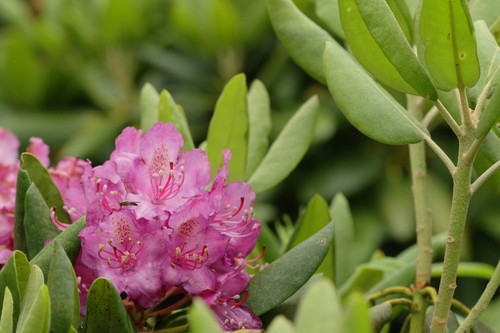
Catawba Rhododendron
Rhododendron catawbiense
The crown jewel of the Appalachian peaks, the Catawba Rhododendron transforms the mountains into a sea of purple every spring. This hardy evergreen is not just a garden favorite but a vital sanctuary for high-altitude wildlife.
Quick Identification
Size
A large evergreen shrub typically reaching 6-10 feet (1.8-3 meters) in height, but can occasionally grow into small trees up to 20 feet (6 meters) tall.
Colors
Dark, glossy green leaves; large clusters of bell-shaped flowers ranging from lilac-purple to rose-pink, often featuring greenish-yellow spots or flares on the upper petal.
Key Features
- Large, leathery evergreen leaves 3-6 inches long
- Showy clusters (corymbs) of 15-20 purple-pink flowers
- Dense, rounded multi-stemmed growth habit
- New growth often has a fuzzy, whitish appearance.
When You’ll See Them
Geographic range
Where Does the Catawba Rhododendron Live?
This iconic shrub is a native treasure of the Eastern United States, primarily concentrated in the Southern Appalachian Mountains. Its range stretches from the rugged peaks of West Virginia southward through Virginia, North Carolina, and Tennessee, reaching its southernmost limits in northern Georgia and Alabama. While most famous for forming massive 'rhododendron slicks' on high-altitude mountain balds, it has been widely introduced as a landscape staple in temperate gardens across North America and Europe.
Basemap © OpenStreetMap contributors
Behavior
The Catawba Rhododendron is a hardy, long-lived evergreen shrub that serves as a cornerstone of the Appalachian ecosystem. While it remains stationary, it exhibits a fascinating 'behavioral' response to temperature known as thermotropism; during freezing winter days, its thick leaves curl tightly and droop to reduce moisture loss and protect against windburn, making it a natural thermometer for backyard observers.
As a social hub for wildlife, this shrub provides vital year-round thermal cover and nesting sites for small birds and mammals. During its spectacular blooming season in late spring and early summer, it becomes a high-traffic destination for pollinators. While beautiful, the plant produces grayanotoxins in its nectar and leaves, a chemical defense that prevents most mammals from over-browsing it, though some specialized insects have evolved to handle its chemistry.
EverydayEarth exclusive
Camera Tips
Capturing the Catawba Rhododendron on your AI-powered camera is less about the plant itself and more about the incredible biodiversity it attracts. To see the 'action,' place your camera on a tripod approximately 3-5 feet away from a cluster of flower buds just before they open. Angle the camera slightly upward to capture the flight paths of incoming pollinators like the Ruby-throated Hummingbird or various swallowtail butterflies against the backdrop of the purple blooms.
Because these shrubs are often found in the understory or on shaded slopes, lighting can be tricky. Position your camera so the morning sun hits the flowers directly, which will help the AI accurately identify the vibrant purple hues and the visitors perched on the petals. If you are using a trigger-based camera, set the sensitivity to high to catch the rapid movement of large bees and hoverflies that frequent the blossoms during peak daylight hours.
In the winter months, don't move your camera! The Catawba Rhododendron is excellent for 'weather-watching.' By aiming your camera at the evergreen leaves, you can capture time-lapse footage of the leaves curling during cold snaps. This also provides a great vantage point for spotting winter birds like Chickadees or Juncos that use the dense foliage for protection from snow and wind. Avoid using heavy baits near the plant; instead, let the natural nectar do the work during the spring bloom.
Similar Species
Species that look similar or are commonly confused with Catawba Rhododendron.
Frequently Asked Questions
Record Catawba Rhododendron at your habitat
Connect a camera to start building your own species record — AI identifies every visitor automatically.