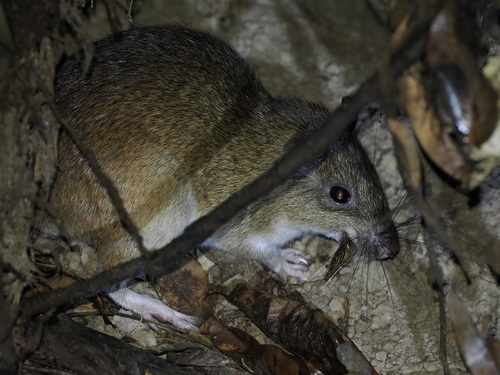
Cayenne Spiny Rat
Proechimys guyannensis
Meet the Cayenne Spiny Rat, a master of the Amazonian understory known for its bristly coat and clever survival tactics. A frequent visitor to nocturnal trail cameras, this resilient rodent is a key player in the health of South American rainforests.
Quick Identification
Size
Body length 17-25 cm (6.7-9.8 in); tail length 12-18 cm (4.7-7.1 in); weight 200-400g (7-14 oz)
Colors
Reddish-brown to gray-brown upperparts with darker spines; creamy white underparts and feet
Key Features
- Flattened, stiff spines mixed with soft fur on the back
- Tail shorter than head-body length and breaks easily
- Large, prominent eyes and rounded ears
- Pale, nearly white belly and chest
When You’ll See Them
Geographic range
Where Does the Cayenne Spiny Rat Live?
This species is a quintessential resident of the Guiana Shield and the northern Amazon Basin in South America. It is natively found across a broad swathe of territory including French Guiana, Guyana, Suriname, and northern Brazil, with its range extending westward into southern Venezuela and eastern Colombia. It is most at home in lowland environments where humidity is high and the forest floor is thick with organic debris.
Basemap © OpenStreetMap contributors
Behavior
The Cayenne Spiny Rat is a terrestrial, nocturnal rodent that spends its nights navigating the complex landscape of the forest floor. While its name suggests a prickly nature, its 'spines' are actually modified, stiffened hairs that lay flat against the body, providing a coarse texture that acts as a deterrent to some predators. They are primarily solitary creatures, establishing small home ranges where they forage along well-worn paths in the leaf litter.
One of the most remarkable behaviors of this species is tail autotomy. Like some lizards, the Cayenne Spiny Rat can shed its tail if grabbed by a predator. The tail does not regenerate, meaning many adults in the wild are found with short, blunt stumps. They are cautious but adaptable, often living in close proximity to human agricultural sites where they take advantage of fallen crops and seeds.
EverydayEarth exclusive
Camera Tips
To successfully capture the Cayenne Spiny Rat on camera, placement is everything. You must position your camera extremely low—ideally 15 to 20 centimeters (6-8 inches) off the ground. These rats are strictly terrestrial and follow 'runways' or clearings under fallen logs and dense ferns. Aim the camera horizontally along the forest floor to capture their profile, which is necessary to see the distinctive spiny texture of their fur.
Because they are highly active in total darkness, a 'No-Glow' or high-quality infrared flash is essential. Standard white light flashes or even some 'Low-Glow' LEDs can startle these rodents, causing them to bolt and potentially avoid the area for several days. If you are using a bait to attract them, a mixture of peanut butter and tropical fruits like mango or banana works wonders. Smear a small amount on a log or a flat rock to keep them in the frame long enough for a clear identification.
Set your camera to a fast trigger speed and high sensitivity. Because they move with a 'scurry-and-stop' motion, short video clips of 10-15 seconds are much more effective than still photos for identifying the species and observing their tail status. If you are placing cameras near a home or farm, look for areas with dense leaf litter and overhead cover, as they rarely cross wide-open spaces where they are vulnerable to owls.
Similar Species
Species that look similar or are commonly confused with Cayenne Spiny Rat.
Frequently Asked Questions
Record Cayenne Spiny Rat at your habitat
Connect a camera to start building your own species record — AI identifies every visitor automatically.