cedar sage
Salvia roemeriana
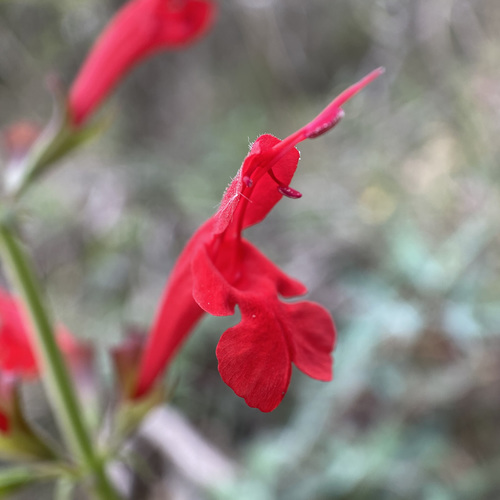
A scarlet treasure of the Texas Hill Country, Cedar sage brings brilliant color to the deepest garden shadows. This shade-tolerant perennial is a magnet for hummingbirds and a favorite for naturalistic woodland landscapes.
Quick Identification
Size
6 to 12 inches (15-30 cm) tall; spreads 8 to 12 inches wide; flower tubes are 1 inch (2.5 cm) long
Colors
Brilliant scarlet or crimson red flowers; dark green foliage, often with purplish undersides on the leaves
Key Features
- Deeply scalloped, heart-shaped basal leaves
- Tubular crimson flowers arranged on upright spikes
- Fine, soft hairs (pubescence) on stems and leaves
- Low-growing, clumping growth habit
When You’ll See Them
Geographic range
Where Does the cedar sage Live?
Cedar sage is native to the North American southwest, with its primary stronghold located in the Edwards Plateau region of Central Texas. Its range extends westward into the mountain canyons of southern Arizona and reaches southward into the rugged, limestone-rich states of northern Mexico, including Coahuila and Nuevo León. While highly specialized to the 'Hill Country' ecology, it is also found in scattered populations throughout the Trans-Pecos region where suitable shaded rocky habitat exists.
Basemap © OpenStreetMap contributors
Behavior
Cedar sage is a hardy perennial that has mastered the art of living in the shadows. Unlike many of its sun-loving cousins in the Salvia genus, this species thrives in the dappled light and deep shade found beneath canopy trees. It spends the winter as a low-profile rosette of rounded, scalloped leaves, hugging the ground to conserve energy. As spring arrives, it sends up slender stalks topped with vibrant red flowers that are specifically shaped to accommodate the long beaks of hummingbirds.
In a backyard ecosystem, Cedar sage acts as a critical early-season nectar source. It is relatively 'social' with other shade-loving plants, often found growing in community with columbines and ferns. While it is quite drought-tolerant once its root system is established, it relies on the cooling mulch of fallen 'cedar' (juniper) needles or oak leaves to regulate soil temperature and moisture. It is also known for its ability to self-seed gently, creating small, beautiful drifts over several seasons without becoming invasive.
EverydayEarth exclusive
Camera Tips
Capturing the beauty of Cedar sage on a backyard camera is less about the plant itself and more about the high-speed wildlife it attracts. To get the best results, place your camera on a short tripod or a ground-level mount, roughly 12 to 18 inches off the ground. Angle the lens slightly upward to frame the vertical flower spikes against a softer, out-of-focus background. This low perspective allows you to see 'into' the tubular flowers where hummingbirds and bees feed.
Because Cedar sage naturally grows in deep shade, lighting can be a challenge for AI cameras. If possible, position your camera so it faces the plant when it receives 'bright shade' or filtered morning sun. If your camera has adjustable settings, increase the ISO slightly or use a wide aperture to ensure the vibrant scarlet of the flowers doesn't appear too dark. Avoid using a heavy flash at night, as it can wash out the delicate textures of the scalloped leaves.
For those using motion-activated cameras to capture pollinators, set your trigger sensitivity to 'High.' Hummingbirds move incredibly fast, so a fast shutter speed or a high-frame-rate video setting (60fps or higher) is essential to avoid a blurry image of a wing. To capture the plant's evening visitors, like Sphinx moths, ensure your camera's infrared or low-light mode is optimized for close-range subjects so the reflective eyes of the moths don't 'blow out' the exposure.
Similar Species
Species that look similar or are commonly confused with cedar sage.
Frequently Asked Questions
Record cedar sage at your habitat
Connect a camera to start building your own species record — AI identifies every visitor automatically.