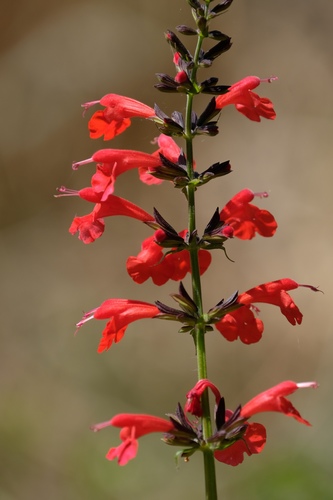
Tropical sage
Salvia coccinea
A vibrant beacon for hummingbirds and butterflies, Tropical sage brings an explosion of scarlet color and wildlife activity to any backyard garden.
Quick Identification
Size
1 to 3 feet (30-90 cm) tall with a spread of 1 to 2 feet (30-60 cm)
Colors
Brilliant scarlet red blooms; triangular green leaves with a soft, hairy texture
Key Features
- Tubular scarlet flowers arranged in loose whorls
- Triangle-to-heart-shaped leaves with scalloped edges
- Square stems characteristic of the mint family
When You’ll See Them
Geographic range
Where Does the Tropical sage Live?
Native to the Americas, Tropical sage is naturally found across the Southeastern United States, stretching from South Carolina through Florida and west to Texas. Its range extends south through Mexico, Central America, and the Caribbean into northern South America, where it thrives in warm, frost-free climates. Due to its popularity in pollinator gardens, it has been introduced as a seasonal resident in temperate regions globally, where it is often grown as a hardy annual.
Basemap © OpenStreetMap contributors
Behavior
Tropical sage is an essential 'anchor' plant for any wildlife-friendly backyard. While it doesn't move like an animal, it exhibits fascinating seasonal behaviors, such as a rapid growth spurt during the peak heat of summer when many other flowers begin to fade. It is a prolific reseeder, often 'walking' across a garden over several seasons as it drops seeds that sprout into a naturalized colony.
This species is a high-energy nectar producer, acting as a social hub for the local ecosystem. It interacts primarily with long-tongued pollinators, particularly hummingbirds and butterflies, who have evolved to access the deep tubes of its scarlet blossoms. Because of its aromatic foliage, it has developed a clever defense behavior—it is naturally resistant to browsing by deer and rabbits, making it a reliable food source for the 'right' visitors.
EverydayEarth exclusive
Camera Tips
To capture the best action around your Tropical sage, position your camera approximately 2 to 3 feet off the ground, angled slightly downward toward the most vibrant cluster of red blooms. This height is the 'sweet spot' for capturing Ruby-throated Hummingbirds and large butterflies like Cloudless Sulphurs as they hover to feed. Use a focal distance of about 3 to 5 feet to ensure the AI can distinguish the fast-moving visitors from the background foliage.
Lighting is crucial for this species; the bright scarlet petals can 'blow out' or lose detail in harsh midday sun. Set your camera to capture its best footage during the mid-morning (8 AM to 10 AM) when the sun is bright enough to allow for high shutter speeds but soft enough to preserve the deep red hues. If your camera has a 'burst mode' or high-frame-rate setting, enable it to freeze the motion of hummingbird wings which move at incredible speeds around these flowers.
Be mindful of the wind. Tropical sage has tall, somewhat flexible stalks that can sway significantly in a breeze, which might trigger false motion alerts on your AI camera. To minimize this, try to plant your sage near a fence or windbreak, or decrease the motion sensitivity of your camera during gusty days. Ensure the lens is clear of any sticky nectar or pollen that might be transferred if a bird brushes against the camera housing.
Don't stop recording when the flowers fade in late autumn. Many backyard birds, particularly goldfinches and sparrows, will visit the spent flower heads to forage for the tiny black seeds. For nighttime enthusiasts, keep the infrared settings active; you may capture the ghostly silhouettes of Sphinx moths—often mistaken for hummingbirds—visiting the blooms under the cover of darkness.
Similar Species
Species that look similar or are commonly confused with Tropical sage.
Frequently Asked Questions
Record Tropical sage at your habitat
Connect a camera to start building your own species record — AI identifies every visitor automatically.