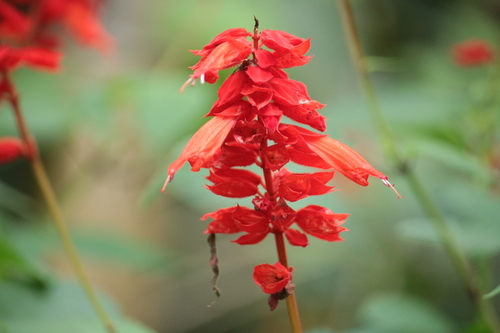
Scarlet Sage
Salvia splendens
The undisputed king of the pollinator garden, Scarlet Sage offers a brilliant explosion of red that draws hummingbirds and butterflies from blocks away.
Quick Identification
Size
Cultivars typically reach 12-24 inches (30-60 cm) in height and width; wild specimens can grow up to 4.3 feet (1.3 m) tall.
Colors
Brilliant scarlet red is the primary color of both the flowers and the bracts, though cultivars exist in purple, pink, and white. Foliage is a deep, vibrant green.
Key Features
- Tall spikes of tubular, two-lipped flowers
- Vibrant red bracts that remain after the flowers drop
- Heart-shaped, serrated green leaves
- Square stems typical of the mint family
When You’ll See Them
Behavior
Scarlet Sage is a powerhouse of the garden, known primarily for its relentless blooming cycle and its ability to act as a beacon for nectar-seeking wildlife. While it grows as a perennial in its native Brazilian highlands, most backyard observers in temperate zones know it as a hardy annual that thrives from late spring until the first frost. Its flowers are specifically evolved for pollination by long-tongued visitors, producing copious amounts of nectar at the base of its tubular corollas.
In a backyard ecosystem, Scarlet Sage acts as a central hub for social interaction among pollinators. You will often observe territorial behavior from hummingbirds who 'claim' a patch of Salvia, chasing away rivals or even large bees. It is a resilient plant that, despite its delicate appearance, can handle high humidity and heat, provided it has enough water to support its lush foliage.
EverydayEarth exclusive
Camera Tips
To capture the best action on your Scarlet Sage, position your camera on a short tripod or stake at the same height as the flower spikes, usually 12 to 24 inches off the ground. Because the primary visitors are fast-moving hummingbirds and sphinx moths, you need to prioritize a fast trigger speed. Set your camera to 'Burst Mode' or 'High-Speed Video' to ensure you catch the split-second moment a bird’s beak enters the tubular flower. Aim the lens at a 45-degree angle to the plant to capture both the side profile of the visitor and the vibrant color of the blooms.
Lighting is your biggest challenge with such a saturated red plant. In bright midday sun, the red can 'blow out' and lose detail on digital sensors. For the most professional-looking shots, capture footage during the 'golden hours' of early morning or late afternoon. The softer light will emphasize the texture of the petals and the iridescent feathers of visiting birds. If your camera allows for exposure compensation, try underexposing by a fraction to keep the reds from becoming a solid blur of color.
Since Scarlet Sage is a magnet for specific wildlife, you can use the plant itself as the 'bait.' Ensure you are focusing on the freshest, most upright flower spikes, as these contain the most nectar and will be the first choice for visitors. If you are using a trail camera, reduce the PIR (motion) sensitivity slightly if the plant is in a windy area, as the waving leaves can cause false triggers. Instead, focus the detection zone specifically on the air space right in front of the flower spikes where hummingbirds hover.
Similar Species
Species that look similar or are commonly confused with Scarlet Sage.
Cardinal Flower
Cardinal flower has much thinner, lance-like leaves and prefers much wetter, swampy soil.
Autumn Sage
Autumn Sage (Salvia greggii) has much smaller, oval leaves and a woodier, shrub-like growth habit compared to the herbaceous Scarlet Sage.
Texas Sage
Texas Sage (Salvia coccinea) has more widely spaced flowers on the stem and is generally more heat-tolerant and leggy in appearance.
Frequently Asked Questions
Record Scarlet Sage at your habitat
Connect a camera to start building your own species record — AI identifies every visitor automatically.