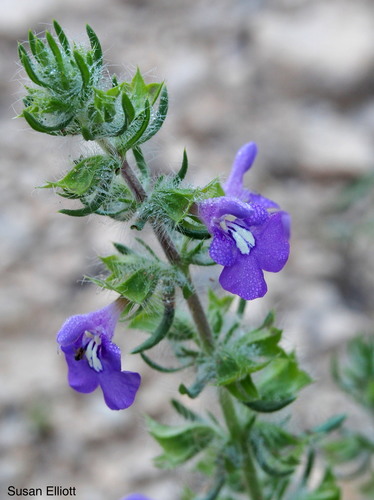
Texas Sage
Salvia texana
A hardy survivor of the limestone prairies, Texas Sage paints the landscape with deep indigo blooms every spring. This low-maintenance native is a powerhouse for pollinators and the perfect centerpiece for a wild-inspired backyard.
Quick Identification
Size
12-24 inches (30-60 cm) tall; flowers are approximately 1 inch (2.5 cm) long
Colors
Deep indigo to violet-blue petals with white or pale markings on the lower lip; dusty green to grayish-green foliage
Key Features
- Distinctive square stems common to the mint family
- Whorls of 2-6 flowers nestled among leafy bracts
- Densely hairy (pubescent) stems and leaves
- Low-growing perennial with a clump-forming habit
- Two-lipped tubular flowers with a larger, lobed lower lip
When You’ll See Them
Behavior
Texas Sage is a resilient perennial wildflower that thrives in the rugged conditions of the American Southwest. Unlike many showier garden cultivars, this species is built for survival, featuring a deep taproot and hairy leaves that help conserve moisture during the scorching Texas summers. It typically begins its growth cycle in early spring, forming a tidy clump of foliage before sending up flowering stalks. Its blooming period is a critical event for local ecosystems, providing an early-season nectar source for a variety of native pollinators.
As a member of the Salvia genus, it exhibits a fascinating pollination mechanism where the flower acts as a lever; when a bee enters the tube to reach the nectar, the stamens tip down to deposit pollen precisely on the insect's back. While it is not aggressive or invasive, it can spread through self-seeding in ideal limestone-rich soils. In a backyard setting, it acts as a low-maintenance anchor for rock gardens, requiring almost no supplemental water once its root system is established.
EverydayEarth exclusive
Camera Tips
To capture the best images of Texas Sage, position your camera at a low 'worm's eye' perspective. Since this plant rarely exceeds two feet in height, mounting your camera on a short stake or a ground-level tripod about 18 inches off the ground will provide the most dramatic view of the indigo flower spikes. If your goal is to document the plant's growth, use a time-lapse setting that takes one photo every 4-6 hours during the spring to watch the flower whorls unfurl and climb the stem.
Because Texas Sage is a magnet for wildlife, it serves as an excellent 'natural bait' for your camera. To capture the insects and birds it attracts, set your camera to a 'Hybrid' mode if available—capturing a high-resolution still followed by a short 10-second video. This allows you to identify fast-moving pollinators like the Blue Orchard Bee or various Skipper butterflies that frequent the blooms. Use a fast shutter speed or a 'Sports' preset to freeze the motion of buzzing wings, which can often be a blur on standard settings.
One of the biggest challenges with photographing wildflowers is wind-induced motion blur. If your camera is motion-triggered, the swaying of the stems on a gusty day can result in hundreds of 'false' triggers. To avoid this, decrease the sensitivity of your motion sensor and try to position the camera so the plant isn't occupying the very edge of the frame where movement is often most exaggerated. Alternatively, use a 'PIR' (Passive Infrared) sensor setting which is less likely to be triggered by the movement of the plant itself and more likely to catch the heat signature of a visiting animal.
For the best lighting, aim for the 'Golden Hours'—shortly after sunrise or just before sunset. The deep blues and purples of the Salvia texana can sometimes 'blow out' or lose detail in the harsh midday Texas sun. If your camera allows for exposure adjustment, slightly underexposing the image can help preserve the rich saturation of the violet petals. During the peak bloom in April, ensure your lens is clean of pollen and dust, which can accumulate quickly in the dry habitats where this plant thrives.
Similar Species
Species that look similar or are commonly confused with Texas Sage.
Frequently Asked Questions
Record Texas Sage at your habitat
Connect a camera to start building your own species record — AI identifies every visitor automatically.