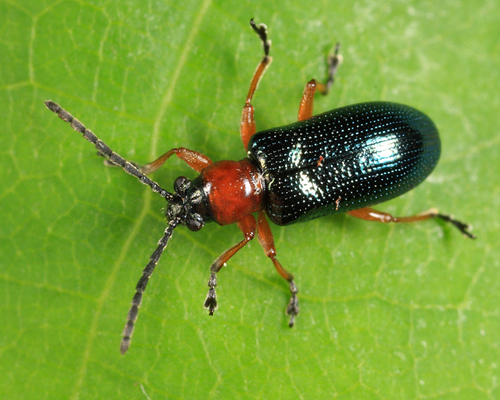
Cereal Leaf Beetle
Oulema melanopus
A tiny traveler with a striking metallic shine, the Cereal Leaf Beetle is a master of adaptation found in meadows and backyards across the globe. Recognizable by its bright orange thorax and unique defensive behaviors, it offers a fascinating look at nature’s micro-world.
Quick Identification
Size
4–6 mm (0.16–0.24 inches) in length; 1.5–2 mm (0.06–0.08 inches) in width
Colors
Metallic blue-black wing covers, bright orange or reddish-brown thorax and legs, and a black head and antennae.
Key Features
- Metallic blue-black elytra (wing covers)
- Bright orange or reddish-brown pronotum (thorax)
- Solid black head and legs
- Distinct rows of tiny punctures on the wings
When You’ll See Them
Geographic range
Where Does the Cereal Leaf Beetle Live?
Native to the temperate regions of Europe, North Africa, and Western Asia, the Cereal Leaf Beetle is a widely traveled insect that has successfully colonized much of the Northern Hemisphere. It was accidentally introduced to North America in the mid-20th century, first appearing in Michigan in 1962, and has since expanded its territory across most of the United States and southern Canada. It thrives wherever small grains or cool-season grasses are cultivated, making it one of the most widespread beetles in temperate climates.
Basemap © OpenStreetMap contributors
Behavior
The Cereal Leaf Beetle is a highly active herbivore known for its fascinating, if somewhat unappealing, survival tactics. Adults emerge from their overwintering spots in early spring, often found in leaf litter or bark, to seek out fresh grasses. They are strong fliers and can disperse rapidly across wide areas, making them a common sight in both agricultural fields and suburban lawns. When threatened, adults often drop from the plant to the ground to hide in the thatch.
The most distinctive behavior occurs during the larval stage. To protect themselves from predators like ladybugs and parasitic wasps, the larvae cover their bodies in a moist coating of their own fecal matter (frass). This 'fecal shield' gives them the appearance of small, slimy black slugs or bird droppings, which deters many birds and predatory insects. This clever, albeit messy, adaptation allows them to feed undisturbed on the tender tissue of grass leaves.
EverydayEarth exclusive
Camera Tips
Capturing the Cereal Leaf Beetle on a backyard camera requires a dedicated macro setup or a high-resolution camera with a very close focal point. Because these beetles are only a few millimeters long, standard wide-angle trail cameras will likely miss them entirely. For the best results, use a camera with a macro lens or a specialized insect camera placed within 3 to 6 inches of the upper leaves of host plants like wheat, oats, or even common lawn grasses.
Since these beetles are most active during the heat of the day, ensure your camera is positioned in a sunlit area. The metallic blue of their wings reflects light beautifully, which can help the camera's sensor lock focus and trigger a recording. Set your camera to a high frame rate or 'burst mode' to capture their movement as they crawl along the edges of grass blades; they are surprisingly quick and can take flight in an instant if they feel a vibration.
A great pro tip for scouting is to look for 'skeletonized' leaves—foliage where the green surface has been eaten away in long strips, leaving a translucent window-pane effect. If you see this damage, place your camera nearby, as it indicates a high probability of finding either the adults or the slug-like larvae. For the larvae, look for what appear to be small, shiny black blobs on the leaves; these are actually the beetles in their protective fecal coating.
Similar Species
Species that look similar or are commonly confused with Cereal Leaf Beetle.
Frequently Asked Questions
Record Cereal Leaf Beetle at your habitat
Connect a camera to start building your own species record — AI identifies every visitor automatically.