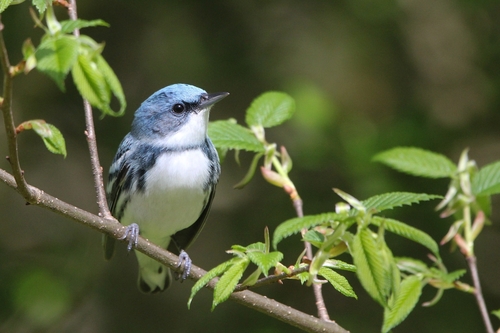
Cerulean Warbler
Setophaga cerulea
A jewel of the high canopy, the Cerulean Warbler is a sky-blue songbird that performs an epic annual migration from the Appalachian peaks to the Andean slopes. Seeing one is a rare treat, as they prefer the sun-drenched leaves of the tallest forest giants.
Quick Identification
Size
Length: 4.3–4.7 in (11–12 cm); Wingspan: 7.5–8 in (19–20 cm); Weight: 0.28–0.35 oz (8–10 g)
Colors
Males are sky-blue above and white below with a black 'necklace'; females are teal or blue-green with yellowish-white underparts.
Key Features
- Brilliant cerulean blue upperparts (males) or teal-green (females)
- Thin black band across the breast (males)
- Two prominent white wing bars
- Small, thin, pointed bill
When You’ll See Them
Geographic range
Where Does the Cerulean Warbler Live?
Native to the Americas, the Cerulean Warbler is a migratory marvel that bridges two continents. During the breeding season, its core range is concentrated in the eastern United States and southern Ontario, with the highest densities found in the Ohio River Valley and the Appalachian Mountains. As the seasons shift, these birds travel thousands of miles to their wintering grounds on the eastern slopes of the Andes Mountains, primarily inhabiting subtropical forests and shade-grown coffee plantations in South America.
Basemap © OpenStreetMap contributors
Behavior
The Cerulean Warbler is a high-canopy specialist, often spending its entire day foraging at the very top of mature deciduous trees. Because they prefer the highest branches, they are notoriously difficult to spot from the ground, a phenomenon birders often call 'warbler neck.' They are incredibly active foragers, moving rapidly through the leaves to glean insects, often hovering momentarily to snatch a caterpillar from the underside of a leaf.
During the breeding season, males are highly territorial and use their buzzy, ascending song to defend their space. Despite their small size, they are aggressive toward intruders. They are long-distance migrants, performing an incredible journey twice a year between the hardwood forests of North America and the tropical slopes of the Andes. They generally avoid human interaction, staying well above the fray of suburban life unless specific habitat requirements are met.
EverydayEarth exclusive
Camera Tips
Capturing a Cerulean Warbler on a backyard camera is one of the ultimate challenges for a wildlife enthusiast. Because these birds rarely descend from the canopy, a standard fence-post or eye-level camera mount will likely never see them. To increase your chances, you must look up. If you have tall, mature hardwood trees like oaks or maples, consider using a pulley system or a long-reach pole to mount a solar-powered camera high within the leaf line. Focus on 'gaps' in the canopy where light breaks through, as these are natural corridors for moving warblers.
The one time these 'canopy ghosts' come down to earth is for water. A bird bath or water feature with a solar-powered 'wiggler' or a constant drip is your best bet for ground-level capture. Use a camera with a high-speed trigger and a burst mode setting, as warblers move exceptionally fast and are prone to motion blur. Set your camera to its highest resolution and use a narrow-angle lens if possible to get closer detail on their intricate plumage.
Seasonality is key for your camera setup. In the eastern U.S., the best window is late April through mid-May when the birds first arrive and the leaves are not yet fully unfurled, providing clearer sightlines. During the height of summer, they are almost impossible to see through dense foliage. Early morning (the first three hours after sunrise) is the peak activity period for singing and foraging; ensure your camera is positioned to avoid direct lens flare from the rising sun by facing it North or South.
Similar Species
Species that look similar or are commonly confused with Cerulean Warbler.
Frequently Asked Questions
Record Cerulean Warbler at your habitat
Connect a camera to start building your own species record — AI identifies every visitor automatically.