Channel Catfish
Ictalurus punctatus
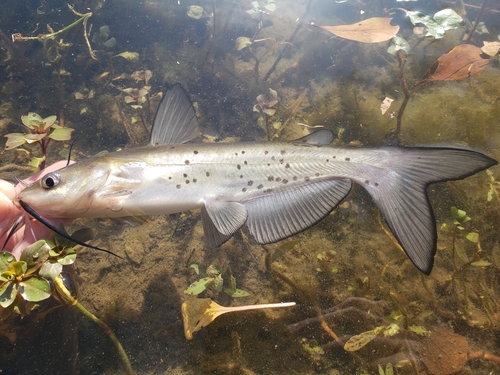
The Channel Catfish is North America's most popular and widespread catfish, known for its sleek spotted body and impressive 'whiskers'. A master of the deep, it uses a full-body sense of taste to navigate and hunt in the murkiest waters.
Quick Identification
Size
Typically 12-24 inches (30-60 cm) and 2-10 lbs (1-4.5 kg), though trophy specimens can exceed 40 inches (100 cm) and 50 lbs (22 kg).
Colors
Olive-brown to bluish-gray back with silvery sides and a white belly; juveniles and medium adults usually feature small, distinct dark spots.
Key Features
- Deeply forked tail fin
- Upper jaw projects beyond the lower jaw
- Eight prominent sensory barbels (whiskers) around the mouth
- Small dark spots on the sides of the body
When You’ll See Them
Geographic range
Where Does the Channel Catfish Live?
Native to the central and eastern regions of North America, the Channel Catfish is most synonymous with the vast Mississippi River basin and the Great Lakes. Its original range extends from southern Canada through the central United States and into northeastern Mexico, covering nearly the entire mid-continent. Due to its popularity as a game fish, it has been widely introduced across the globe, establishing significant populations in parts of Europe, South America, and Asia.
Basemap © OpenStreetMap contributors
Behavior
Channel Catfish are highly adaptable and active foragers that rely heavily on their sophisticated senses of taste and smell. Unlike many other catfish that are strictly bottom-dwellers, Channel Cats are known to move throughout the water column to find food. They possess taste buds over their entire body surface, allowing them to detect chemical signatures in murky water long before they see their prey.
These fish are generally more active during the night and in low-light conditions, though they will feed during the day if the water is turbid or cloudy. During the spawning season in late spring and early summer, they become quite territorial. Males are responsible for selecting and defending nesting sites—usually dark, secluded cavities like hollow logs, undercut banks, or rock crevices—where they guard the eggs and fry with great ferocity.
EverydayEarth exclusive
Camera Tips
To capture high-quality footage of Channel Catfish, an underwater action camera (like a GoPro) or a specialized submersible trail camera is essential. Position your camera near natural underwater structures such as submerged logs, large rocks, or the edge of a vegetation line. These 'high-traffic' areas serve as highways for catfish looking for cover or a place to ambush prey. Setting the camera at a slight upward angle towards the surface can help capture the silhouette of the fish against the natural light filtering down.
Because Channel Catfish are scent-driven, using a 'chum' or lure is the most effective way to bring them directly in front of your lens. Place a mesh bag filled with high-scent bait—such as chicken livers, canned corn, or commercial stink bait—about 2-3 feet away from the camera lens. This ensures the fish stay in the frame while they investigate the smell. Secure the bait bag to a heavy weight or an anchor to prevent the fish from dragging it out of the camera's view.
Visibility is the biggest challenge when filming catfish. Choose a day after several days of dry weather when the water is clear and the sediment has settled. If you are filming at night, which is when they are most active, you will need an infrared (IR) light source to avoid scaring the fish with bright white light. Many submersible cameras have built-in IR LEDs, but adding an external IR floodlight can significantly increase the depth of field and clarity of your nighttime aquatic captures.
Similar Species
Species that look similar or are commonly confused with Channel Catfish.
Frequently Asked Questions
Record Channel Catfish at your habitat
Connect a camera to start building your own species record — AI identifies every visitor automatically.