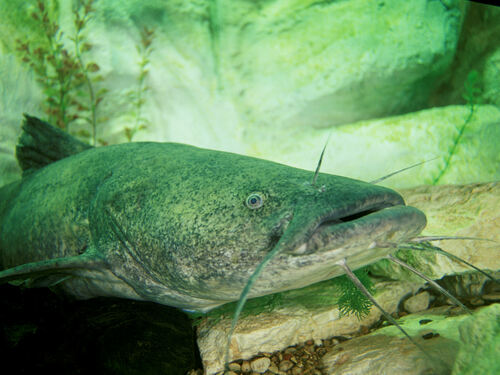
Flathead Catfish
Pylodictis olivaris
The undisputed heavyweight of the river bottom, the Flathead Catfish is a master of ambush and underwater shadows. With its distinctive shovel-shaped head and solitary nature, this apex predator offers a fascinating glimpse into the hidden depths of North American waterways.
Quick Identification
Size
Typically 38–114 cm (15–45 in) long and 5–20 kg (11–45 lbs), though trophy specimens can reach 155 cm (61 in) and over 55 kg (120 lbs).
Colors
Mottled yellow-olive, olive-brown, or dark brown on the back and sides, fading to a pale yellow or creamy white belly.
Key Features
- Broad, flattened head with a protruding lower jaw
- Squared-off or slightly notched tail fin, never deeply forked
- Small, beady eyes positioned on the top of the head
- Prominent sensory barbels (whiskers) around the mouth
When You’ll See Them
Geographic range
Where Does the Flathead Catfish Live?
Native to the freshwater systems of North America, the flathead catfish is primarily found throughout the Mississippi, Missouri, and Ohio River basins. Its range extends from the lower Great Lakes south into the Gulf states and down into the river systems of northern Mexico. While it is a staple of the central United States, it has been widely introduced to Atlantic slope rivers where it is often managed as an invasive apex predator.
Basemap © OpenStreetMap contributors
Behavior
Flathead catfish are the solitary 'lone wolves' of the river bottom. Unlike many other catfish species that may school together, flatheads are highly territorial and aggressive predators. They spend their daylight hours tucked away in 'holts'—dark, sheltered spots such as submerged hollow logs, undercut banks, or dense piles of woody debris. They are remarkably sedentary during the day, often staying in the exact same spot for hours, perfectly camouflaged against the murky substrate.
As nocturnal specialists, flatheads become active hunters under the cover of darkness. They are ambush predators that rely on their sensitive whiskers and lateral lines to detect the vibrations of nearby prey. While they appear sluggish, they are capable of explosive bursts of speed when striking. Interactions with humans are generally limited to angling, though they are known to be quite curious about underwater equipment and will vigorously defend their nesting sites during the spawning season.
EverydayEarth exclusive
Camera Tips
To successfully capture a flathead catfish on camera, you must think like a bottom-dweller. Because they are strictly aquatic, you will need a waterproof trail camera or a submerged action cam setup. Look for 'snags'—fallen trees or large root balls in slow-moving water. Flatheads love these structures for cover. Position your camera near the entrance of a potential 'hole' or log jam, keeping the lens about 6-12 inches off the riverbed to get a clear profile view of the fish as it emerges to hunt at night.
Lighting is the biggest challenge when filming underwater. Flathead catfish are light-sensitive, so it is crucial to use 'no-glow' infrared (940nm) flash. Traditional white light or visible red glow LEDs will likely spook the fish or cause them to stay tucked deep inside their cover. If the water is murky, try to position the camera closer to the target area (2-3 feet) to reduce 'backscatter'—the reflection of light off suspended particles in the water which can blur the image.
While flatheads aren't scavengers, you can attract them to your camera's field of view by creating a 'chum' zone of movement. A small mesh bag filled with live baitfish (where local regulations allow) secured just outside the camera's frame can create the vibrations and scent trails necessary to draw an apex predator out of hiding. Late spring is an ideal time for placement, as the fish move into shallower rocky areas to spawn and become more visible and active during the day.
Similar Species
Species that look similar or are commonly confused with Flathead Catfish.
Frequently Asked Questions
Record Flathead Catfish at your habitat
Connect a camera to start building your own species record — AI identifies every visitor automatically.