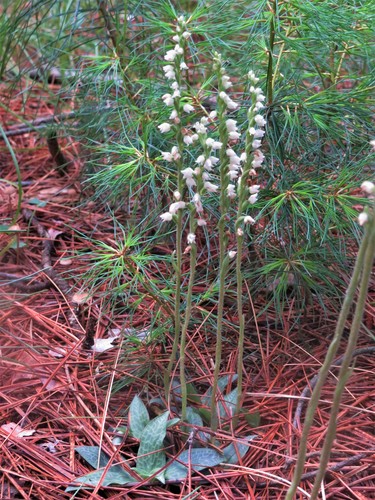
checkered rattlesnake plantain
Goodyera tesselata
Meet the checkered rattlesnake plantain, a secretive woodland orchid with stunning 'snake-skin' leaves that stays green even under the winter snow.
Quick Identification
Size
Leaves 2-7 cm (0.8-2.7 in) long; flowering stalk 15-35 cm (6-14 in) tall
Colors
Blue-green or dark green leaves with pale silvery-white or light green checkered veins; creamy white flowers
Key Features
- Basal rosette of blue-green leaves
- Distinctive white checkered or 'tessellated' vein pattern
- Single unbranched flowering stalk with fine glandular hairs
- Small, hooded white flowers arranged in a loose spiral
When You’ll See Them
Geographic range
Where Does the checkered rattlesnake plantain Live?
Native to North America, the checkered rattlesnake plantain is primarily found across the temperate and boreal regions of Eastern Canada and the Northeastern United States. Its core range spans from the dense woodlands of Manitoba and Ontario eastward to Newfoundland, and reaches south through New England to Maryland, with western populations extending into the Great Lakes forests of Minnesota. This orchid is a specialist of the northern forest understory, where it thrives in the stable, shaded microclimates of old-growth and maturing secondary forests.
Basemap © OpenStreetMap contributors
Behavior
During the mid-to-late summer, the plant produces a single reproductive stalk. This stalk is covered in tiny, sticky hairs and bears a series of small, nectar-rich flowers. These blossoms are specifically designed to accommodate bumblebees, which are the primary pollinators. After pollination, the plant produces tiny, dust-like seeds that are dispersed by the wind, though it can also spread slowly through underground rhizomes to form small colonies.
EverydayEarth exclusive
Camera Tips
For those using AI-powered trail cameras or time-lapse setups, the flowering window in July and August offers the best opportunity for dynamic content. Set your camera to a time-lapse mode with an interval of one photo every 20 to 30 minutes. Over several days, you can capture the 'spike' emerging and the individual hooded flowers spiraling open. Since these orchids grow in the deep shade of the forest canopy, ensure your camera settings are optimized for low-light conditions; a wider aperture or a slightly higher ISO will help maintain detail in the dark greens of the leaves without needing a harsh, artificial flash.
If you're interested in the wildlife that interacts with the checkered rattlesnake plantain, aim your camera at the flower spike during the day. Bumblebees are the most frequent visitors, and a high-speed video setting can capture the fascinating way they pry open the hooded blossoms to reach the nectar. Be careful not to disturb the surrounding soil or moss when placing your camera, as the delicate fungal network the orchid relies on is highly sensitive to compaction and foot traffic.
Similar Species
Species that look similar or are commonly confused with checkered rattlesnake plantain.
Frequently Asked Questions
Record checkered rattlesnake plantain at your habitat
Connect a camera to start building your own species record — AI identifies every visitor automatically.