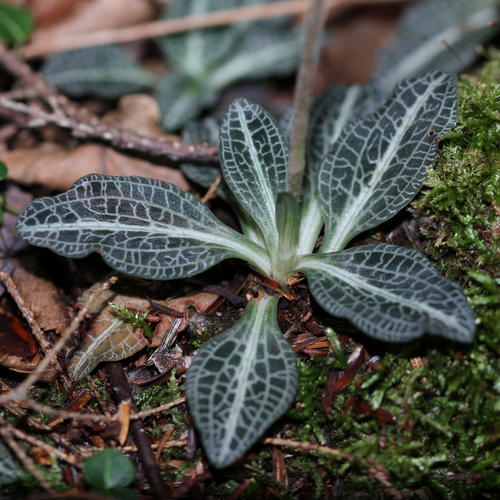
downy rattlesnake plantain
Goodyera pubescens
The crown jewel of the forest floor, the downy rattlesnake plantain features stunning 'snake-skin' leaves that stay green even under the winter snow.
Quick Identification
Size
Stands 6-18 inches (15-45 cm) tall; basal leaves 1-3 inches (3-8 cm) long
Colors
Dark bluish-green leaves with striking silvery-white reticulated veins; creamy white fuzzy flowers
Key Features
- Intricate silvery-white 'snake-skin' leaf venation
- Basal rosette of evergreen leaves
- Dense spike of 20-50 small hooded flowers
- Distinctly downy or fuzzy stem and petals
When You’ll See Them
Geographic range
Where Does the downy rattlesnake plantain Live?
Native to the temperate regions of eastern North America, the downy rattlesnake plantain is a staple of the Appalachian woods and northern forests. Its range extends from the coastal provinces of Atlantic Canada and Nova Scotia down through the eastern United States to the Florida panhandle, reaching as far west as Minnesota, Oklahoma, and the Ozarks. It is most frequently encountered in stable, older-growth forests where the leaf litter provides the perfect substrate for its fungal associates.
Basemap © OpenStreetMap contributors
Behavior
The downy rattlesnake plantain is a terrestrial orchid known for its unique symbiotic relationship with mycorrhizal fungi in the soil. This partnership is essential for the plant's survival, as the fungi help the orchid's tiny, dust-like seeds germinate and provide vital nutrients to the adult plant. Because of this, the species is difficult to transplant and thrives best in undisturbed, mature ecosystems where the soil chemistry remains stable.
Unlike many forest wildflowers that disappear in winter, this orchid is evergreen. Its basal rosette of patterned leaves hugs the ground year-round, performing photosynthesis even on warmer winter days. During mid-to-late summer, it sends up a single, fuzzy stalk topped with a cluster of small, nectar-rich flowers that attract various long-tongued bees and small butterflies. It spreads slowly through underground rhizomes, often forming small, charming colonies on the forest floor.
EverydayEarth exclusive
Camera Tips
To capture the stunning detail of the downy rattlesnake plantain, you need to get your camera low. For the best results, use a ground-level stake or a small tripod that allows the lens to sit just a few inches above the leaf litter. This orchid is a perfect subject for macro photography; if your AI camera has a close-focus mode, use it to highlight the 'reptilian' texture of the white veins against the dark green leaves, which is its most famous feature.
While the leaves are a year-round subject, the flowering spike in mid-summer offers a chance for 'action' shots. Position your camera to face the flowering stalk from a side-on angle rather than top-down. This will allow you to capture the 'downy' hairs on the stem. If you are using a trail camera with video capabilities, set it to short 10-second bursts during the day; you are likely to catch bumblebees and other pollinators visiting the hooded blossoms.
Lighting is your best friend with this species. In a dense forest canopy, the light can be dappled and harsh. Try to set up your camera during 'golden hour' or on a slightly overcast day to avoid blown-out white spots on the highly reflective leaf veins. Since the plant doesn't move, you can use slower shutter speeds if your camera allows, which will help bring out the deep, rich greens of the foliage in the shaded forest understory.
Similar Species
Species that look similar or are commonly confused with downy rattlesnake plantain.
Lesser Rattlesnake Plantain
Features a one-sided flower spike and leaves with fewer, less intricate white veins.
Checkered Rattlesnake Plantain
Found more in western and northern regions, it has smaller rosettes and more sparsely veined leaves.
Striped Wintergreen
Has similar white-veined leaves but they are serrated and grow on a woody stem rather than in a flat basal rosette.
Frequently Asked Questions
Record downy rattlesnake plantain at your habitat
Connect a camera to start building your own species record — AI identifies every visitor automatically.