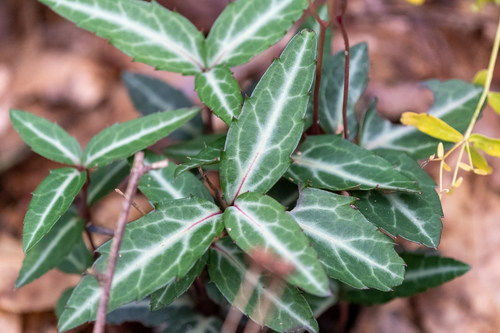
striped wintergreen
Chimaphila maculata
A striking woodland treasure, striped wintergreen brightens the forest floor with its variegated evergreen leaves and waxy, nodding summer blooms. This resilient perennial maintains its beauty year-round, forming a secret partnership with the soil to survive the deep shade.
Quick Identification
Size
Height of 10–25 cm (4–10 inches); leaves 2–7 cm (0.8–2.8 inches) long
Colors
Dark forest-green leaves with a distinct white or silver-white stripe along the midvein; waxy white to pale pink flowers
Key Features
- Variegated dark green leaves with a prominent white midrib stripe
- Waxy, nodding white or pinkish flowers with five petals
- Low-growing, evergreen habit that persists through winter
- Whorled or opposite leaf arrangement on a brownish-purple stem
When You’ll See Them
Geographic range
Where Does the striped wintergreen Live?
Striped wintergreen is a hardy native of Eastern North America, with a range that stretches from the southern borders of Quebec and Ontario down through the Appalachian corridor to northern Florida. It extends westward into the Great Lakes region and Illinois, favoring the well-drained, acidic soils of mature woodlands. Remarkably, this species also appears in disjunct populations further south, thriving in the mountainous highland forests of Mexico and Central America as far south as Panama.
Basemap © OpenStreetMap contributors
Behavior
Striped wintergreen is a quiet, slow-growing resident of the forest floor. Unlike many other forest plants that disappear in the autumn, it is evergreen, maintaining its striking variegated leaves throughout the winter. It has a fascinating symbiotic relationship with soil fungi (mycorrhizae), which helps it obtain nutrients in the shaded, acidic, and often nutrient-poor soils it prefers. While it does produce energy through photosynthesis, this plant is considered 'mixotrophic,' meaning it partially relies on its fungal partners for sustenance.
The plant blooms in mid-summer, producing delicate, downward-facing flowers that hang like tiny lamps. These flowers are designed for buzz-pollination, a technique where bumblebees vibrate their wing muscles at a specific frequency to dislodge pollen. Because it spreads via underground rhizomes, you will often find striped wintergreen growing in small, loose colonies rather than as isolated individuals. To humans, it is a sign of a healthy, mature woodland ecosystem, and its leaves have historically been used in folk medicine and for flavoring root beer.
EverydayEarth exclusive
Camera Tips
Capturing the subtle beauty of striped wintergreen requires a 'macro' mindset. Since the plant rarely grows taller than 10 inches, you need to mount your camera very low to the ground. Use a ground spike or a small flexible tripod to get the lens level with the nodding flowers. To get the best results, angle the camera slightly upward; this allows you to see inside the downward-facing 'bells' of the flowers, which are the most photogenic part of the plant during the summer bloom.
For those using AI-powered backyard cameras, movement-based triggers are unlikely to fire for the plant itself. Instead, use a time-lapse setting. A photo taken every 15 to 30 minutes during July can capture the slow, graceful opening of the waxy petals. If you are specifically looking to capture the bumblebees that visit for buzz-pollination, set your camera to high-sensitivity video mode during the warmest hours of the day (10 AM to 2 PM), focusing on a cluster of open blooms.
Lighting is the biggest challenge in the deep shade where this species thrives. If your camera allows for exposure adjustment, bump it up slightly to capture the contrast of the white stripes against the dark green leaves. During the winter, this plant is a fantastic subject for 'snow photography.' The dark evergreen leaves create a stunning visual contrast against a fresh layer of snow. Ensure your camera's white balance is adjusted so the snow doesn't appear blue, and you'll have a striking winter wildlife scene even when the animals are in hibernation.
Similar Species
Species that look similar or are commonly confused with striped wintergreen.
Frequently Asked Questions
Record striped wintergreen at your habitat
Connect a camera to start building your own species record — AI identifies every visitor automatically.