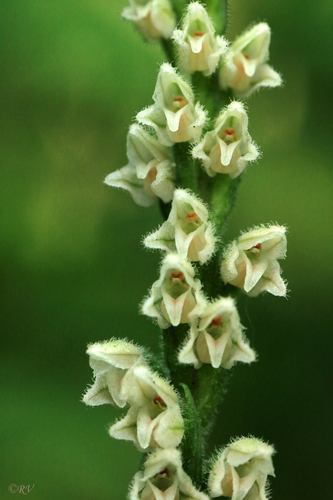
lesser rattlesnake plantain
Goodyera repens
A miniature marvel of the forest floor, the lesser rattlesnake plantain is a hardy orchid known for its stunning white-veined leaves and delicate summer blooms. It is a master of survival in the deep shade of ancient evergreen woods.
Quick Identification
Size
Flower stalks reach 10-25 cm (4-10 in) tall; basal leaves are 2-4 cm (0.8-1.6 in) long.
Colors
Dark forest green leaves with prominent silvery-white reticulated veins; flowers are white or pale cream.
Key Features
- Evergreen basal rosette of leaves
- White net-like veining resembling snakeskin
- One-sided spiral of tiny, bell-shaped white flowers
- Stalk covered in fine glandular hairs
When You’ll See Them
Geographic range
Where Does the lesser rattlesnake plantain Live?
The lesser rattlesnake plantain enjoys a vast circumpolar distribution across the Northern Hemisphere. It is native to the temperate and boreal regions of North America, stretching from Alaska across Canada to the Atlantic coast, and dipping south into the Appalachian Mountains and the Great Lakes region. Beyond the Americas, its range extends across Europe, including the pine forests of Scotland and Scandinavia, and reaches through northern Asia into Russia, China, and Japan.
Basemap © OpenStreetMap contributors
Behavior
The lesser rattlesnake plantain is a fascinating perennial orchid that spends much of its life in a quiet, creeping state. Unlike many showy garden plants, this species relies on a complex underground network. It is strongly mycotrophic, meaning it maintains a symbiotic relationship with soil fungi to help it absorb nutrients, particularly during its long germination period which can take several years before the first leaves even appear above the moss.
Once established, the plant spreads slowly across the forest floor using horizontal stems called stolons, forming small colonies or carpets. While the leaves are evergreen and provide visual interest year-round, the plant only sends up a flower spike when conditions are ideal, typically in mid-summer. It does not "behave" in the animal sense, but it is highly sensitive to soil compaction and changes in canopy cover, making it an excellent indicator of a healthy, undisturbed forest ecosystem.
EverydayEarth exclusive
Camera Tips
Capturing the lesser rattlesnake plantain requires a different approach than traditional wildlife. Since this is a stationary subject, your goal is to use your AI-powered camera's high-resolution and macro capabilities to highlight the intricate 'snakeskin' pattern of the leaves. Position your camera on a low-profile tripod or directly on the forest floor using a beanbag for stability. A slight upward angle toward the flower spike can create a majestic 'forest giant' perspective for this tiny orchid.
Because these orchids grow in deep shade, lighting is your biggest challenge. Avoid using a harsh direct flash, which can wash out the delicate white veins. Instead, use a reflector or a diffused LED light to gently fill in the shadows. If your camera supports time-lapse mode, set it to take a photo every 30 minutes during the blooming season in July. This allows you to capture the slow unfurling of the spiral flower spike, a process that is invisible to the naked eye but stunning when sped up.
Don't just focus on the plant itself; use your camera's motion-trigger settings to capture the pollinators. These orchids are often visited by small sweat bees and bumblebees. By setting a narrow 'zone of interest' around the flower head, you can capture high-quality images of these insects interacting with the orchid. Ensure your shutter speed is high (at least 1/500s) if you are trying to freeze the motion of visiting insects.
Finally, consider the seasonal transition. Because the leaves are evergreen, they provide a rare splash of color against the winter snow. If you live in a region with snowfall, keep your camera out during the winter months. The contrast of the dark green and white patterned leaves against a fresh powder provides some of the most striking botanical photography possible in a backyard woodland setting.
Similar Species
Species that look similar or are commonly confused with lesser rattlesnake plantain.
Frequently Asked Questions
Record lesser rattlesnake plantain at your habitat
Connect a camera to start building your own species record — AI identifies every visitor automatically.