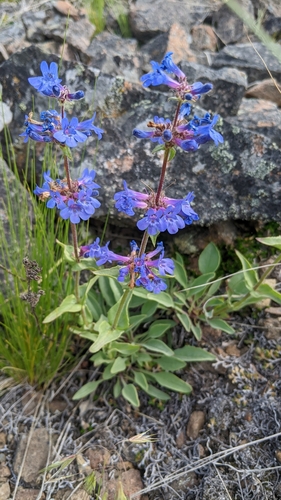
Chelan Penstemon
Penstemon pruinosus
A gem of the Pacific Northwest shrub-steppe, the Chelan Penstemon stands out with its 'frosted' blue foliage and electrifying violet blossoms. It is a vital early-season sanctuary for native bees and hummingbirds.
Quick Identification
Size
Stands 10–30 cm (4–12 inches) tall with flowers measuring approximately 1.5–2 cm (0.6–0.8 inches) in length.
Colors
Brilliant deep blue to violet-purple flowers; foliage is a distinctive glaucous blue-gray with a waxy, frosted appearance.
Key Features
- Waxy, blue-gray 'frosted' leaves and stems
- Vibrant indigo to violet tubular blossoms
- Compact, low-growing perennial habit
- Fine, sticky glandular hairs on the upper flower stalks
When You’ll See Them
Geographic range
Where Does the Chelan Penstemon Live?
The Chelan Penstemon is a regional specialist native to the Pacific Northwest of North America. Its core range is concentrated on the eastern slopes of the Cascade Mountains in Washington State, extending from the Wenatchee Mountains northward into the southern interior of British Columbia, Canada. It is most commonly found in the sun-drenched, semi-arid landscapes of the Columbia River Basin and the Okanagan Valley, where it thrives in the dry air of the mountain rain shadow.
Basemap © OpenStreetMap contributors
Behavior
While it doesn't move like an animal, this species exhibits 'behavior' through its specialized pollination strategy. The tubular shape of its flowers is perfectly designed for long-tongued bees and hummingbirds. It is a social plant in the sense that it often grows in loose colonies, creating blankets of blue across rocky slopes that help stabilize the thin soils of its arid habitat.
EverydayEarth exclusive
Camera Tips
To capture the stunning indigo hues of the Chelan Penstemon, position your camera on a low tripod or a ground mount, keeping the lens roughly 6 to 10 inches from the ground. This low-angle perspective highlights the tubular structure of the flowers and the 'frosted' texture of the waxy leaves. For the best color saturation, shoot during the 'golden hours' of early morning or late afternoon; the high-desert midday sun can often wash out the deep blues and purples of the petals.
Because these wildflowers are a magnet for native pollinators, you can use your AI-powered camera to capture incredible insect and bird activity. Set your camera to 'Burst Mode' or a high-frame-rate video setting (60fps or higher) and focus specifically on a healthy cluster of open blooms. This species is particularly attractive to Mason bees and hummingbirds. By treating the flower as a natural 'lure,' you can capture high-quality footage of these fast-moving visitors as they hover and feed.
If you are using a trail camera for long-term monitoring, choose a spot sheltered from the heavy winds common in the Columbia Basin to avoid motion-blur. A time-lapse setting is ideal for this species; capturing one frame every hour from late April through May will allow you to document the spectacular transition from a dormant rosette to a full-bloom floral display. Ensure your camera is set to a macro or close-focus mode if available, as the intricate 'beard' of hairs inside the flower throat is a key identifying feature.
Similar Species
Species that look similar or are commonly confused with Chelan Penstemon.
Frequently Asked Questions
Record Chelan Penstemon at your habitat
Connect a camera to start building your own species record — AI identifies every visitor automatically.