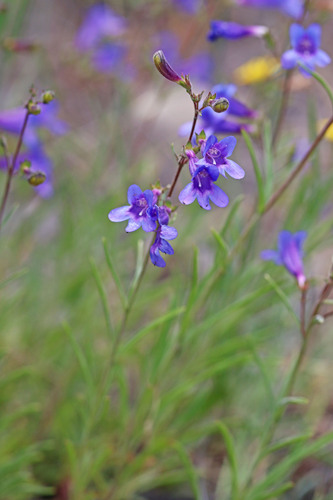
Roezl's penstemon
Penstemon roezlii
A hardy survivor of the Sierra Nevada, Roezl's penstemon erupts in brilliant blue-purple tubular blooms every summer. This mountain-loving wildflower is a vital nectar source for high-altitude hummingbirds and bees.
Quick Identification
Size
Grows up to 55 cm (22 inches) tall; leaves reach up to 7 cm (2.8 inches) in length.
Colors
Flowers are shades of blue-purple; foliage is a dusty grey-green with hairy textures.
Key Features
- Wide-mouthed tubular flowers in shades of blue-purple
- Hairy, erect stems growing from a woody base
- Linear or lance-shaped leaves often folded lengthwise
- Thin glandular hairs on the outer surfaces of the blossoms
When You’ll See Them
Geographic range
Where Does the Roezl's penstemon Live?
Roezl’s penstemon is native to the rugged landscapes of the Western United States. It is primarily found across the mountains and high-desert scrub of Oregon, western Nevada, and northern California, with strongholds in the Klamath Mountains and the Sierra Nevada range. This resilient wildflower thrives in the volcanic soils and rocky forest edges characteristic of the Pacific Northwest and the Great Basin transition zones.
Basemap © OpenStreetMap contributors
Behavior
Roezl’s penstemon is a hardy perennial herb that exhibits a resilient growth pattern suited for the harsh conditions of rocky outcrops and high-altitude forests. Unlike many delicate garden flowers, this species builds a woody, branching base over several years, allowing it to withstand heavy snowmelt and dry summers. It emerges in late spring, sending up erect, hairy stems that culminate in a vibrant display of tubular blooms designed to attract specific long-tongued pollinators.
The plant plays a vital role in its ecosystem by providing a high-energy nectar source during the mid-summer months. Its tubular flower shape is perfectly evolved for hummingbirds and larger bees, which must crawl deep into the wide-mouthed 'throat' of the flower to reach the nectar, inadvertently collecting pollen on their backs. While it doesn't move like an animal, the plant is highly reactive to light and moisture, with its leaves often folding lengthwise to conserve water during the heat of the day.
EverydayEarth exclusive
Camera Tips
To capture the stunning blue-purple hues of Roezl’s penstemon, place your camera on a low-profile tripod or a ground stake. Because these plants typically grow on rocky slopes or in sagebrush, a camera height of 12 to 18 inches is ideal. Angle the lens slightly upward to showcase the 'wide-mouthed' interior of the tubular flowers, which is where most of the visual interest—and pollinator action—occurs.
Since the primary goal is often to capture the wildlife that visits the flower, set your camera to 'Burst Mode' or a high-speed video setting. Roezl’s penstemon is a favorite of the Rufous Hummingbird and various bumblebee species. High shutter speeds are necessary to freeze the motion of these fast-moving visitors. If your camera has a macro lens or a close-focus setting, use it to highlight the glandular hairs on the flower’s exterior, which are a key identifying feature of this species.
Lighting is critical for this plant. The blue-purple pigment can easily look washed out in the harsh midday sun of the high mountains. The best shots are usually captured during the 'golden hour'—the hour after sunrise or before sunset—when the low light emphasizes the texture of the hairy stems and the deep color of the petals. Avoid using a heavy flash, as it can reflect off the glandular hairs and create unwanted glare; instead, rely on natural ambient light for a more authentic wilderness feel.
Similar Species
Species that look similar or are commonly confused with Roezl's penstemon.
Frequently Asked Questions
Record Roezl's penstemon at your habitat
Connect a camera to start building your own species record — AI identifies every visitor automatically.