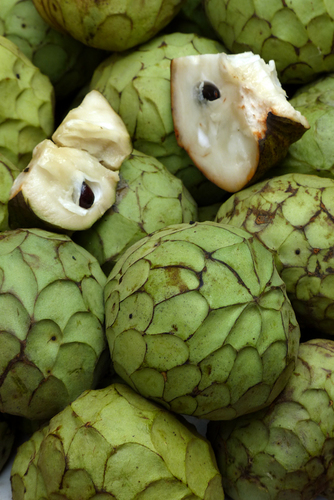
Cherimoya
Annona cherimola
Known as the 'Custard Apple,' the Cherimoya is a lush Andean tree prized for its creamy, heart-shaped fruit. It transforms suburban gardens into tropical escapes, attracting a diverse range of pollinators and fruit-loving wildlife.
Quick Identification
Size
Trees reach 5–9 m (16–30 ft) tall; fruits typically 10–20 cm (4–8 in) long and weighing 150g–500g (0.3–1.1 lbs)
Colors
Pale green bark, dark green leaves with velvety rust-colored undersides, light green heart-shaped fruit with white creamy flesh and black seeds
Key Features
- Heart-shaped green fruit with scale-like skin depressions
- Ovate, velvety leaves with prominent veins
- Fragrant, drooping yellowish-green flowers with three fleshy petals
- Spreading evergreen to semi-deciduous canopy
When You’ll See Them
Geographic range
Where Does the Cherimoya Live?
The Cherimoya is native to the Andean valleys of South America, primarily within the high-altitude regions of Ecuador, Peru, Bolivia, and Colombia. It thrives in the 'eternal spring' climates of these mountainous areas where temperatures are moderate and humidity is consistent. Beyond its native range, it has been widely introduced and successfully cultivated in Central America, Mexico, Southern California, Southern Spain, and parts of the Mediterranean and Australia.
Basemap © OpenStreetMap contributors
Behavior
The Cherimoya is a fascinatng semi-deciduous tree that undergoes a unique growth cycle. In late spring, it often drops its old foliage just as new buds and flowers begin to emerge, a strategy that helps it manage water in its native highland habitats. The tree is most famous for its complex pollination behavior; the flowers are protogynous, meaning they open as females in the morning and transition to a male, pollen-producing stage by the following afternoon. This timing prevents self-pollination and requires specific insects or human intervention to successfully set fruit.
In a backyard ecosystem, the Cherimoya tree acts as a significant hub for local biodiversity. Its broad, dense leaves provide excellent nesting sites and shade for birds, while its fragrant flowers attract specialized beetles and bees. When the fruit ripens, it becomes a high-energy food source for various mammals. While the tree itself is stationary, its growth is rapid in the right conditions, and it responds significantly to pruning and seasonal changes, making it an engaging subject for long-term observation.
EverydayEarth exclusive
Camera Tips
To capture the fascinating life of a Cherimoya tree, focus your camera on the development of the fruit or the unique flowering process. For the flowers, set your AI camera to a macro or close-up mode and position it within 2 feet of a flower cluster. Because these flowers change sex from female to male over a 24-hour period, a time-lapse setting that captures an image every 30 minutes will allow you to see the fleshy petals open and the internal structures change. This is best done in late spring when flowering is at its peak.
If you want to document the wildlife that visits the tree, place your camera on a branch or a nearby tripod at 'fruit height' (usually 4–7 feet). As the fruit ripens and its scent becomes more potent, you are likely to capture nocturnal visitors like opossums, raccoons, or even large fruit-eating birds. Ensure your camera is set to trigger on motion with a high-quality infrared flash, as many of these interactions happen under the cover of darkness. Positioning the camera to look down a fruiting branch can provide a dramatic perspective of the 'custard apples' as they grow and soften.
For gardeners interested in pollination, aim your camera at the flowers during the early morning and late afternoon. This is when the tiny Nitidulid beetles, the tree's primary pollinators, are most active. Because these insects are small, use the highest resolution possible and ensure the camera is shaded by the tree’s canopy to avoid harsh glare and overexposure. Monitoring the undersides of the broad, velvety leaves can also reveal a variety of beneficial insects or caterpillars that use the tree as a host.
Similar Species
Species that look similar or are commonly confused with Cherimoya.
Frequently Asked Questions
Record Cherimoya at your habitat
Connect a camera to start building your own species record — AI identifies every visitor automatically.