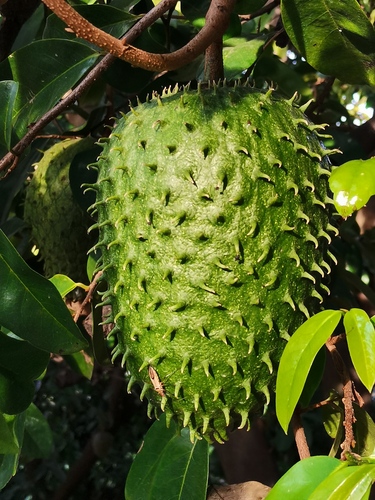
Soursop
Annona muricata
The Soursop is a tropical marvel, famous for its giant, prickly green fruits and its ability to attract a diverse array of garden pollinators. This low-branching evergreen turns any backyard into a lush, aromatic sanctuary for both people and wildlife.
Quick Identification
Size
Height: 25-30 feet (7.6-9.1 meters); Fruit: 4-12 inches (10-30 cm) long and up to 15 lbs (6.8 kg)
Colors
Glossy dark green leaves; yellowish-green fruit with soft spines; creamy white interior pulp
Key Features
- Heart-shaped green fruit covered in pliable, soft spines
- Large, glossy evergreen leaves with a pungent aroma when crushed
- Three-petaled, pale yellow flowers that emerge directly from the trunk or branches
- Low-branching, bushy growth habit with a somewhat open canopy
When You’ll See Them
Behavior
The Soursop is a fast-growing, evergreen tree known for its distinctive 'cauliflorous' habit, meaning it produces flowers and fruit directly on its main trunk and older branches. While it doesn't move like the animals usually captured on EverydayEarth cameras, it is a hive of activity. The tree serves as a critical host for various pollinators, particularly small beetles and moths, which are attracted to the thick, fleshy petals of its flowers that emit a strong, fruity scent at night.
In a backyard ecosystem, the Soursop acts as a magnet for wildlife. As the heavy fruits ripen, they release an intoxicating aroma that draws in fruit-eating birds, bats, and small mammals. Because the fruit is so heavy and often hangs low to the ground, it facilitates unique interactions between terrestrial and arboreal species. Humans often value the tree not just for its edible fruit but for the dense shade its broad leaves provide in tropical climates.
EverydayEarth exclusive
Camera Tips
Capturing the Soursop on your EverydayEarth camera is best approached as a study in both botany and the wildlife it attracts. Because the fruit often grows low on the trunk, set your camera at a height of 2-4 feet, angled slightly upward. This allows you to witness the fascinating transition from flower to fruit over several months. Using a time-lapse setting is highly recommended; taking one photo every 24 hours can create a stunning sequence of the heavy, prickly fruit swelling to maturity.
To capture the animals that visit the tree, focus your lens on a ripening fruit. Many tropical birds will peck at the fruit during the day, while nocturnal visitors like fruit bats or opossums will arrive under the cover of darkness. Set your camera's trigger sensitivity to high, as the movement of small pollinators around the flowers can be subtle. If your camera has a macro mode, use it to get close-up shots of the thick, prehistoric-looking yellow flowers.
If you are looking to record 'theft' in your garden, place the camera 5-10 feet away with a wide-angle view. You'll likely catch squirrels or larger birds attempting to breach the soft, spiny skin of the fruit. Since Soursop thrives in humid environments, ensure your camera housing is equipped with anti-fog inserts to prevent lens condensation during the early morning hours when the tree is most likely to be covered in dew.
Similar Species
Species that look similar or are commonly confused with Soursop.
Frequently Asked Questions
Record Soursop at your habitat
Connect a camera to start building your own species record — AI identifies every visitor automatically.