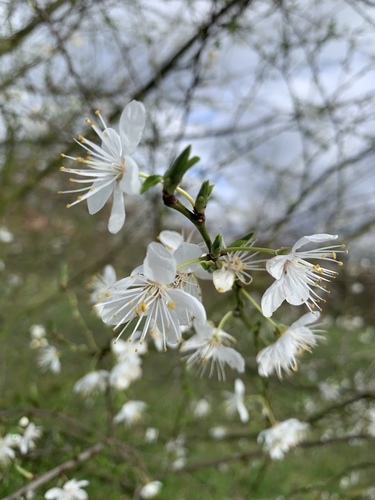
Cherry-plum
Prunus cerasifera
A herald of the changing seasons, the Cherry-plum offers a spectacular display of early blossoms and a summer bounty of sweet fruit. It is a vital sanctuary and fueling station for backyard pollinators and songbirds alike.
Quick Identification
Size
Height of 6–12 meters (20–40 feet) with a canopy spread of 4–6 meters (13–20 feet).
Colors
Dark brown to nearly black bark; leaves range from bright green to deep purple or burgundy; flowers are pure white or soft pink.
Key Features
- Early spring blooms appearing before leaves
- Small, round fruit (2-3 cm) in red or yellow
- Finely serrated, elliptical leaves
- Smooth bark that develops shallow fissures with age
- Often multi-stemmed or shrub-like in growth.
When You’ll See Them
Behavior
The Cherry-plum is one of the first trees to wake up after winter, often bursting into full bloom while other species are still dormant. This early flowering strategy makes it an essential resource for queen bumblebees and other early-emerging pollinators seeking their first nectar of the year. Its dense branching habit provides excellent nesting cover for small songbirds and protection from predators.
As the season progresses, the tree transitions from a floral spectacle to a fruit-bearing powerhouse. The small drupes (plums) ripen in mid-summer, attracting a wide variety of wildlife. While the tree itself is stationary, its 'behavior' is defined by its rapid growth and high reproductive output, often forming thickets if left unmanaged. It is highly resilient to urban pollution and varied soil types, making it a common sight in both wild hedgerows and suburban landscapes.
EverydayEarth exclusive
Camera Tips
To capture the best action on a Cherry-plum, timing is everything. During the early spring flowering phase (February to April), mount your camera on a nearby branch or a tripod positioned 2-3 feet from a dense cluster of blossoms. Use a high shutter speed or 'burst mode' to capture the rapid movement of honeybees and hoverflies. If your camera has a macro lens or a close-focus setting, this is the time to use it.
In the summer months, shift your focus to the ripening fruit. Position your camera at a height of 4-6 feet, aiming at a branch heavy with red or yellow plums. This is the best way to record visits from birds like Robins, Starlings, and Waxwings. For backyard trail cameras, consider placing the camera on the ground near the base of the tree to catch mammals like squirrels, foxes, or even deer that come to forage for fallen fruit.
Because the Cherry-plum's white blossoms can be highly reflective in bright sunlight, try to angle your camera slightly away from direct midday sun to avoid 'blowing out' the highlights. Early morning or late afternoon light provides a warmer glow that highlights the texture of the bark and the translucence of the leaves. If you are tracking growth, a long-term time-lapse setting can beautifully document the transition from bud to blossom over a two-week period.
Similar Species
Species that look similar or are commonly confused with Cherry-plum.
Blackthorn
Smaller flowers that appear before leaves; much more thorny with smaller, sour blue-black fruit (sloes).
Common Plum
Generally has larger leaves and larger, more oval fruit; flowers slightly later than the Cherry-plum.
Hawthorn
Flowers much later (May), with deeply lobed leaves and distinctive red berries (haws) in autumn.
Frequently Asked Questions
Record Cherry-plum at your habitat
Connect a camera to start building your own species record — AI identifies every visitor automatically.