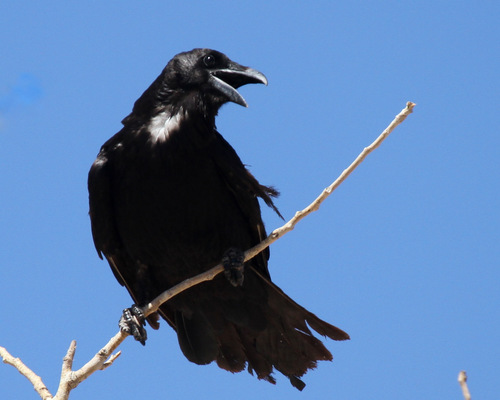
Chihuahuan Raven
Corvus cryptoleucus
A master of the desert sky, the Chihuahuan Raven is the 'white-necked' ghost of the arid Southwest. Intelligent and highly social, these glossy black birds are iconic fixtures of the desert-scrub landscape.
Quick Identification
Size
Length 48–53 cm (19–21 in), wingspan 102–110 cm (40–43 in), weight 380–670 g (13–24 oz)
Colors
Entirely black plumage with a subtle violet-blue iridescence; distinctive white bases on the neck and throat feathers (usually hidden)
Key Features
- White feather bases on the neck visible only in wind or display
- Nasal bristles extending halfway down the heavy bill
- Tail is slightly rounded or wedge-shaped
- Social behavior with large winter flocks
- Distinctive 'pruk' or 'crrrrk' vocalizations
When You’ll See Them
Geographic range
Where Does the Chihuahuan Raven Live?
Native to the North American continent, the Chihuahuan Raven thrives in the arid landscapes of the Southwestern United States and Northern Mexico. Its core range spans from southeastern Arizona and New Mexico through the plains of Texas, reaching as far north as western Kansas and southeastern Colorado. In Mexico, it is a common resident across the Central Plateau and the Chihuahuan Desert, where it occupies a niche between the more forest-loving Common Raven and the more urban-adapted American Crow.
Basemap © OpenStreetMap contributors
Behavior
Chihuahuan Ravens are highly intelligent and social corvids, often found in larger groups than their more solitary cousin, the Common Raven. They are masters of the arid landscape, frequently seen soaring over desert scrub or congregating in large communal roosts during the winter months. Their social structure is complex; they often forage in coordinated groups to exploit temporary food gluts, such as insect swarms or agricultural harvests.
Interaction with humans is common in ranching communities and on the outskirts of desert towns, where they have learned to associate human activity with potential food. While naturally wary, they are quick learners and can become quite bold if they discover a reliable food source. Unlike many other desert birds, they are well-adapted to the heat, often seen perched on utility poles or windmills where they can catch cooling breezes while scanning the ground for prey.
EverydayEarth exclusive
Camera Tips
To capture the Chihuahuan Raven on camera, you must respect their high intelligence and keen eyesight. These birds are 'neophobic,' meaning they are naturally suspicious of new objects in their environment. When placing an AI-powered camera in your backyard or on a trail, camouflage is your best friend. Use a camera with a matte finish and consider wrapping it in a desert-tan burlap or using a dedicated housing that mimics the surrounding rock or scrub. Place the camera at a height of 3 to 5 feet, angled slightly upward if targeting a perch, or downward toward a clear patch of ground if using a lure.
In the desert, water is often a more powerful lure than food. A shallow birdbath or a dripping water feature will attract ravens much more reliably than a standard feeder. If you choose to use food as a lure, suet blocks or protein-rich scraps work well, but be prepared for the birds to inspect the area for several days before landing. For the best lighting, position your camera facing north or south to avoid the harsh midday glare of the desert sun, which can wash out the raven's black plumage and hide its subtle iridescent sheen.
Settings-wise, use a fast shutter speed or a high-frame-rate video mode. Ravens are incredibly quick, and their takeoff is explosive; a slow trigger speed will often result in a 'ghost' of a tail feather rather than a clear shot. If your camera allows for 'pre-trigger' recording, enable it to catch the moment they descend from the sky. Because they are most active during the cooler morning and late afternoon hours, ensure your camera's sensitivity is adjusted for the high-contrast light typical of those times.
Similar Species
Species that look similar or are commonly confused with Chihuahuan Raven.
Frequently Asked Questions
Record Chihuahuan Raven at your habitat
Connect a camera to start building your own species record — AI identifies every visitor automatically.