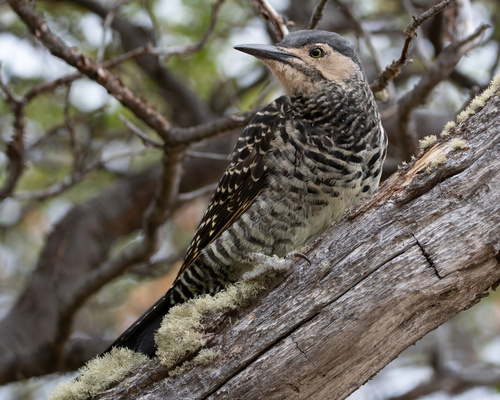
Chilean Flicker
Colaptes pitius
The Chilean Flicker is a charismatic, ground-dwelling woodpecker native to the temperate forests and fields of Chile and Argentina. Known for its loud 'Pitío' call and intricate barred plumage, it is a master of the forest edge.
Quick Identification
Size
Length of 30–34 cm (12–13.5 in); weight approx 150–170g (5.3–6 oz)
Colors
Brownish-grey upperparts with heavy buff barring; creamy-white underparts heavily barred with dark brown; grey face with a dark crown; males feature a small red malar (mustache) stripe.
Key Features
- Extensive dark barring across the entire breast and belly
- Long, slightly decurved dark bill
- Greyish-brown face lacking the black 'bib' of North American flickers
- Large white rump patch visible in flight
When You’ll See Them
Geographic range
Where Does the Chilean Flicker Live?
The Chilean Flicker is a hallmark species of the southern cone of South America. It is natively found throughout the majority of Chile, ranging from the southern fringes of the Atacama Desert down to the rugged landscapes of the Magallanes region. Its territory also extends into southwestern Argentina, hugging the Andean foothills and the lush Valdivian temperate forests. Unlike some high-altitude relatives, it is a versatile resident of both coastal lowlands and mountain slopes.
Basemap © OpenStreetMap contributors
Behavior
The Chilean Flicker, known locally as the 'Pitío' after its piercing call, is a distinctive woodpecker that breaks the family mold by spending a significant portion of its time on the ground. Unlike many of its relatives that hammer deep into wood, the Chilean Flicker is a terrestrial specialist, hopping across open pastures and forest clearings with a distinctive upright posture. They are highly social birds, often seen in pairs or small family groups of three to five individuals, communicating with a series of loud, repetitive whistles that can be heard from a great distance.
In human-altered landscapes, they have become remarkably adaptable. They are frequently observed in rural gardens and near farmsteads, where they use fence posts as lookout points. When threatened, they take to the air with a characteristic undulating flight pattern, flashing a bright white rump that serves as a visual signal to other members of their group. During the breeding season, their social interactions become more complex, involving synchronized head-bobbing displays and vocal duets between mates.
EverydayEarth exclusive
Camera Tips
To successfully capture a Chilean Flicker on a backyard or trail camera, you must focus on the ground. These birds are 'ground-flickers,' meaning they spend more time probing the earth for ants than they do clinging to trees. Place your camera on a low mount or even a stable rock, positioned only 12 to 18 inches above the soil. Look for areas with short grass or disturbed earth near the base of old trees, as these are prime foraging spots. Angle the lens slightly downward to ensure you catch the bird as it probes the ground with its beak.
Water is a massive draw for this species. A ground-level birdbath or a shallow saucer of water placed in a quiet corner of your yard will almost certainly attract them for drinking and bathing. Position your camera about 5 feet away from the water source. Because flickers are naturally skittish, use a camera with a fast trigger speed (0.3 seconds or less) and set it to take 3-photo bursts. This increases your chances of catching the bird in a clear, still pose between its frequent, nervous head movements.
If you are setting up in a more wooded area, keep an ear out for their loud 'drumming.' During the spring (September through November), males will drum on resonant surfaces to mark territory. While they prefer hollow logs, they have been known to use metal poles or chimneys. If you find a favorite 'drumming post,' mount your camera at eye level facing the trunk. Avoid using heavy baits like birdseed, which they rarely eat; instead, leave a patch of your lawn unmowed to encourage natural ant colonies, which are the ultimate lure for a Chilean Flicker.
Similar Species
Species that look similar or are commonly confused with Chilean Flicker.
Frequently Asked Questions
Record Chilean Flicker at your habitat
Connect a camera to start building your own species record — AI identifies every visitor automatically.