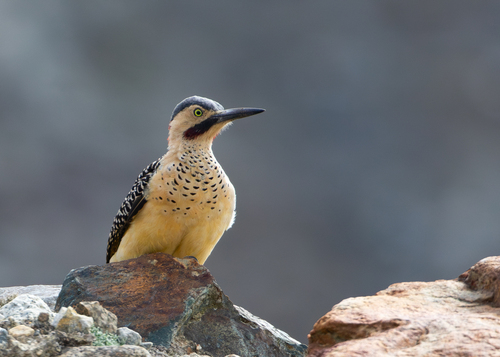
Andean Flicker
Colaptes rupicola
Meet the woodpecker that traded trees for the high-altitude plains of the Andes. The Andean Flicker is a charismatic, ground-dwelling bird known for its golden wing flashes and social nature.
Quick Identification
Size
32 cm (12.6 inches) in length; wingspan of approximately 50-55 cm (20-22 inches); weight 150-200 grams (5.3-7.1 oz)
Colors
Buff-white underparts with heavy dark spotting; grayish-brown back with fine dark bars; golden-yellow shafts on wing and tail feathers; males have a red mustache (malar) stripe, while females have a black one.
Key Features
- Large terrestrial woodpecker often seen walking on the ground
- Golden-yellow feather shafts visible in flight
- Spotted buff breast and belly with a distinct dark malar stripe on males
When You’ll See Them
Geographic range
Where Does the Andean Flicker Live?
Native to the rugged landscapes of South America, the Andean Flicker is a master of the high-altitude cordilleras. Its core range stretches along the backbone of the Andes, spanning from northern Ecuador through Peru and Bolivia into northern Chile and northwestern Argentina. Unlike many birds that shy away from the thin air, this species thrives in the expansive puna grasslands and rocky outcrops found at elevations where trees often fail to grow.
Basemap © OpenStreetMap contributors
Behavior
Unlike most members of the woodpecker family, the Andean Flicker is almost entirely terrestrial. It has adapted to the treeless landscapes of the high Andes by spending its days foraging on the ground, walking or hopping across the grass rather than climbing trunks. They are remarkably social birds, frequently seen in pairs or small family groups, and they communicate with loud, piercing calls that echo across the mountain valleys.
Nesting behavior is equally unique for this species; instead of excavating holes in wood, they dig burrows into earth banks, cliffs, or even the walls of abandoned buildings. They are generally bold around human settlements, often frequenting high-altitude pastures and the edges of mountain villages where they can be observed probing the soil for food.
EverydayEarth exclusive
Camera Tips
Because Andean Flickers are terrestrial, the traditional 'birdhouse' camera height will not work. Position your trail camera low to the ground, ideally between 12 and 24 inches high, angled slightly upward. Focus on open areas of short grass or near rocky outcroppings where they frequently forage for ants. If you can locate a nesting bank or a frequently used earth mound, these are prime spots for high-quality captures.
These birds are most active during the cooler morning hours before the midday sun becomes too intense. Set your camera to a multi-burst or high-speed 'photo' mode; flickers are fast movers, and capturing the golden flash of their wings as they take flight requires a quick trigger speed. Avoid placing cameras in areas with tall, swaying grass that might cause false triggers in the high Andean winds.
While they don't visit traditional bird feeders, they are often attracted to areas with slightly disturbed soil or muddy patches where insects are easier to find. If setting up a camera in a backyard or farm setting, a low-profile water basin or birdbath placed on the ground can be an excellent lure, as these birds need to drink and bathe regularly in the dry mountain air.
Similar Species
Species that look similar or are commonly confused with Andean Flicker.
Frequently Asked Questions
Record Andean Flicker at your habitat
Connect a camera to start building your own species record — AI identifies every visitor automatically.