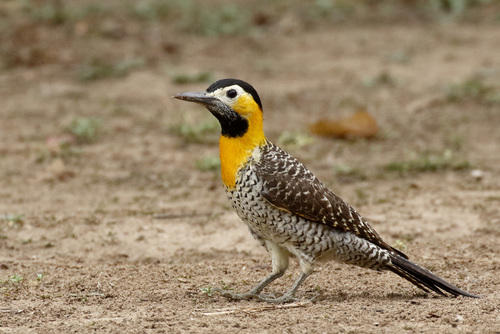
Campo Flicker
Colaptes campestris
A striking, golden-necked woodpecker that prefers the grass to the trees. The Campo Flicker is a social, ground-dwelling bird that brings a flash of brilliant yellow and bold personality to the South American landscape.
Quick Identification
Size
Length of 28–31 cm (11–12.2 in); weight ranges from 145–190 g (5.1–6.7 oz)
Colors
Bright golden-yellow face and neck, black crown, brown-and-white barred back, and a white rump. Males have a red malar (mustache) stripe, while females have a blackish or mottled one.
Key Features
- Brilliant golden-yellow throat and neck
- Solid black crown contrasting with yellow face
- Large white rump patch highly visible in flight
- Frequently seen standing on the ground or termite mounds
When You’ll See Them
Geographic range
Where Does the Campo Flicker Live?
The Campo Flicker is a signature bird of South America, primarily found east of the Andes. Its core range encompasses the vast interior of Brazil, extending southward through the grasslands of Paraguay and Uruguay into the pampas of central Argentina. While it is a lowland specialist in most of its range, it is an adaptable resident that has successfully colonized suburban parks and agricultural landscapes throughout these countries.
Basemap © OpenStreetMap contributors
Behavior
These birds are known for their 'greeting ceremonies,' where individuals face each other, bob their heads, and flick their wings to display their plumage. While they are capable of excavating nesting holes in trees, they are equally comfortable using arboreal termite mounds or even holes in banks. They are bold and relatively well-adjusted to human presence, often perching prominently on fence posts or utility poles to scan for predators or territory intruders.
EverydayEarth exclusive
Camera Tips
To capture the best footage of a Campo Flicker, you need to think like a ground-dweller. Place your AI-powered camera low—about 10 to 15 inches off the ground—mounted on a small stake or the base of a tree. Aim the lens toward flat, grassy areas where you have seen ants or termite activity, as these birds spend the majority of their day probing the soil for food. Because they are often found in open areas, ensure your camera is positioned to avoid backlighting; a south-facing orientation (in their native range) will provide the most consistent light on their vibrant yellow feathers.
If you have a large property, look for lone fence posts or small termite mounds. Campo Flickers use these as 'lookout towers' to survey the area. Mounting a camera nearby, focusing on the top of the post or mound, is a surefire way to get high-quality, stationary shots. They are also very attracted to water, especially in drier climates or during the summer months. A ground-level birdbath or a simple shallow dish of water with a small solar dripper will act as a magnet for them, as they are frequent drinkers and bathers.
During the breeding season, usually between September and January, keep an eye out for nesting activity. They may use old fence posts or dead trees. If you find a nest site, place your camera at a respectful distance (at least 10-15 feet) with a clear line of sight to the entrance hole. This can capture fascinating behavior such as food delivery to chicks and the 'changing of the guard' between parents. Use a high-sensitivity motion setting, as their hops across the ground can be quick and erratic.
Similar Species
Species that look similar or are commonly confused with Campo Flicker.
Frequently Asked Questions
Record Campo Flicker at your habitat
Connect a camera to start building your own species record — AI identifies every visitor automatically.