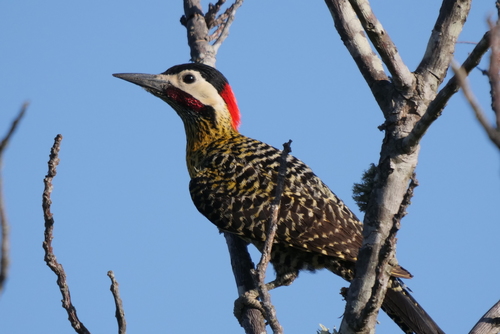
Green-barred Woodpecker
Colaptes melanochloros
Meet South America's golden-barred beauty, a versatile woodpecker that is just as comfortable hopping on your lawn as it is drumming on a tree. With its shimmering olive plumage and bold red nape, the Green-barred Woodpecker is a stunning visitor to any backyard camera.
Quick Identification
Size
Length: 27–30 cm (10.6–11.8 in); Weight: 110–170 g (3.9–6 oz)
Colors
Golden-olive upperparts with black barring, pale yellow underparts with black spots, red nape patch, and a black crown. Males have a red malar (mustache) stripe; females have a black one.
Key Features
- Distinctive golden-green back with horizontal black bars
- Bright red patch on the back of the head (nape)
- Heavy black spotting across the chest and belly
- Long, slightly decurved dark bill for ground probing
When You’ll See Them
Geographic range
Where Does the Green-barred Woodpecker Live?
The Green-barred Woodpecker is a native treasure of South America, thriving across a massive footprint in the southern half of the continent. Its core population resides in the varied landscapes of Brazil, Argentina, Paraguay, Uruguay, and southeastern Bolivia. From the humid Atlantic forests to the semi-arid Chaco and the grassy pampas, this species has successfully colonized nearly every habitat that offers a mix of trees and open foraging ground.
Basemap © OpenStreetMap contributors
Behavior
The Green-barred Woodpecker, often referred to as a South American flicker, is a remarkably adaptable bird. Unlike many woodpeckers that spend most of their time clinging to vertical trunks, this species is frequently seen hopping across the ground in search of food. They are social yet territorial, often seen in pairs or small family groups, communicating with a series of loud, rhythmic 'kwick-kwick-kwick' calls that can be heard from a distance.
In backyard settings, they are bold and relatively tolerant of human presence, provided they have access to mature trees for nesting and open ground for foraging. They spend a significant portion of their day excavating ant hills or probing the soil. During the breeding season, they become more vocal and active, drumming on hollow logs or even metal structures to signal their presence to rivals and potential mates.
EverydayEarth exclusive
Camera Tips
To capture the Green-barred Woodpecker on camera, you need to think beyond the tree trunk. Because this species is a frequent ground-feeder, placing your AI-powered camera 12 to 18 inches off the ground near an ant mound or a recently watered patch of lawn can yield incredible close-up footage. Angle the camera slightly downward to capture their distinctive hopping gait and 'probing' behavior as they search for insects in the grass.
If you prefer a traditional feeder setup, use a suet cage filled with high-fat cakes or a platform feeder with fresh fruit like oranges or papaya. Mount the camera about 5 to 7 feet high, facing the feeder with the sun at your back to highlight the golden-olive hues of their feathers. They are also highly attracted to water; a shallow bird bath on a pedestal is an excellent 'set' for capturing high-quality video of them bathing and preening.
Set your camera to take short video bursts (15-20 seconds) rather than just stills, as their rhythmic pecking and social interactions are fascinating to watch. Use a high-sensitivity trigger setting, as their movements on the ground can be quick. Early morning is the best time for lighting and activity, especially during the warmer months when they are most active near suburban dwellings.
Similar Species
Species that look similar or are commonly confused with Green-barred Woodpecker.
Frequently Asked Questions
Record Green-barred Woodpecker at your habitat
Connect a camera to start building your own species record — AI identifies every visitor automatically.