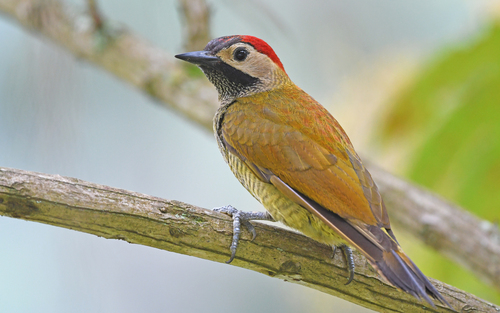
Golden-olive Woodpecker
Colaptes rubiginosus
A striking bird of the tropical canopy, the Golden-olive Woodpecker is famous for its shimmering green-gold wings and bold, barred underparts. A common and charismatic visitor to forest edges, it is a favorite for backyard birders across the Americas.
Quick Identification
Size
Length 18–23 cm (7–9 in); Weight 60–90 g (2.1–3.2 oz)
Colors
Golden-olive upperparts and wings, pale yellow underparts with dense black horizontal barring, red nape on both sexes; males have a red malar stripe.
Key Features
- Golden-olive back and wings with a metallic sheen
- Broad yellow-and-black barred belly
- Bright red patch on the nape
- Male has a distinct red 'mustache' or malar stripe
When You’ll See Them
Geographic range
Where Does the Golden-olive Woodpecker Live?
The Golden-olive Woodpecker is native to the Americas, spanning a massive territory from Mexico and Central America through much of South America. It is commonly found throughout the Andean region in countries like Colombia, Ecuador, Peru, and Bolivia, as well as across Venezuela and parts of Argentina. While it thrives in the humid tropics, it is notably absent from the driest coastal regions and the southernmost tip of the continent.
Basemap © OpenStreetMap contributors
Behavior
The Golden-olive Woodpecker is a spirited and vocal member of the forest canopy, often recognized by its loud, piercing 'kwee-kwee-kwee' calls. Unlike some of its more reclusive relatives, this species is relatively social and is frequently seen in pairs or small family groups. They are expert climbers, using their stiff tail feathers as a tripod to brace themselves against tree trunks while they hitch upward in a spiral pattern in search of hidden insects.
These birds are known for their rhythmic drumming on hollow logs, which serves as a primary method of communication for defending territory and attracting mates. In areas with human habitation, they have proven surprisingly adaptable, often visiting shaded coffee plantations or mature suburban gardens where tall trees are present. They are primarily diurnal, spending their mornings foraging intensely before resting in the shade during the hottest part of the day.
EverydayEarth exclusive
Camera Tips
To capture the shimmering metallic tones of the Golden-olive Woodpecker, place your AI-powered camera on a vertical trunk of a mature tree at a height of about 1.5 to 2.5 meters (5 to 8 feet). These birds prefer the main trunk or large, horizontal branches for foraging. If you have a dead tree or a 'snag' in your yard, this is the gold standard for placement, as they are naturally drawn to these spots for both drumming and searching for wood-boring larvae.
Baiting is a highly effective way to bring this species into your camera's field of view. Suet feeders are a favorite, especially those containing nuts or dried fruit. For a more natural look on camera, you can create a 'log feeder' by drilling shallow holes into a fallen branch and filling them with a mixture of peanut butter and birdseed. This mimics their natural foraging behavior and keeps them stationary in front of the lens for much longer than a standard perch would.
The best lighting for these birds is early morning sun, which highlights the golden-green sheen of their wings. Avoid placing the camera where it will be pointing directly into the sun, as the high contrast can wash out the intricate barring on their bellies. Set your camera's trigger interval to the shortest possible time, as woodpeckers can be erratic in their movements, often hopping to the other side of the tree in a split second. Using a 'burst' photo mode or high-definition video will ensure you catch the perfect frame of their red nape or malar stripe.
Similar Species
Species that look similar or are commonly confused with Golden-olive Woodpecker.
Frequently Asked Questions
Record Golden-olive Woodpecker at your habitat
Connect a camera to start building your own species record — AI identifies every visitor automatically.